Showing posts with label musings. Show all posts

Monday, April 27, 2015

A Personal Essay on Love and Loneliness

Photo by Wesley Eller; https://creativecommons.org/licenses/by/2.0/
This essay is an expansion of my earlier imitation essay and post, "Fill me with Loneliness, Drink it as Love."
The Reality of Love as the Potential for Loneliness
It fills every silent corner and rolls across each room like the booming ticks of a small mantle clock. Frightening, pervasive, indelible, and ever-stalking the peace of solitude. How is it possible that nobody else notices it? It must be just me. If I'd not grown up in the cacophonous hubbub of pattering feet, wrestling limbs, and chattering voices, or if I had simply taken more time when I had time, I wouldn't feel it either.

It highlights the pictures of family members I haven't seen in months. It feeds off of white noise making my situation more obvious. It dredges up memories that I wish weren't so distant. It paints brilliant hypotheticals that I can only imagine I'm missing.


It isn't homesickness; the place I grew up is only the canvas of my contented existence. It is more than that. It distances me from familiar faces, close conversations, family jokes, company. Hard times, yellowed memories, happy times, youthful escapades. It proves to me that acclimating to a location is not nearly as powerful as acclimating to a soul.


It's loneliness, and I am really good at it.


Where does it come from? I'll tell you where it comes from. Everywhere. From the fact that Spencer is working late tonight, unable to help chase it away. From the fact that I just got off a phone call with words that couldn't be spoken in person. From empty evenings brimming with homework instead of siblings' orchestra concerts, soccer games, first words, and story time—I tell myself that it's okay, I'll make up lost time, I won't be so busy and isolated for much longer. It comes from having responsibilities that I can't ignore till I'm abandoned by any company because I first abandoned them. It comes from sitting silently wishing someone would knock on the door, going to sleep alone, waking alone, walking alone, thinking alone.


It comes when I realize that my siblings are growing up and I'm not there. When "Hey, it's Natalie!" becomes a frequent reference to a calling device instead of my face. When me coming home is an occasion and not the everyday. It comes when I remember that my five-year-old brother cried in a corner outside the temple because he thought my wedding meant he'd never see me again. I held him and whispered promises; I prayed because I felt the gaps of time chasing me down. It comes when another brother tries not to cry when I leave, or a sister clutches me saying, "call me, we'll figure out what to talk about." When I say I'll teach her to crochet someday, or I'll read him Harry Potter, that I'll teach her French, we'll analyze Lord of the Rings, talk about boys, play frisbee, go on walks, go shopping, go to a movie, go on a double date, practice yoga, learn to draw, stargaze from the roof, roast s'mores, or sit and do nothing.


Oh wait, I don't have time to do nothing, no matter how important, I'm too busy being laboriously lonely.


Sometimes I am a well of loneliness. I can dig into my soul like deep earth and etch out the regrets of all that I'm missing. But, loneliness is surprisingly similar to love. And, though I'm good at loneliness, the imprint on my being while a void to me, houses love for others. I fill up my cavity with water to share. Each voicemail, each letter, each picture might fill me with loneliness, but I drink it as love. Some youngest siblings may tell you that they were always alone or that their older siblings didn't care. Not my siblings. Phone calls and letters. Skype and short visits. Ongoing texts full of riddles, ongoing conversations full of to-be-continued. And how do you think I feel about that?


Give you one guess.


~~~❋~~~


Till experienced, loneliness and love are quite different. But, in fact, they are nearly the same, causal even. I began to understand the correlation by understanding how I love and how I am lonely. When I love someone, my physical and emotional state shifts. I seem to create a pocket in my heart like a labeled cubby hole in a preschool classroom.


Every person I love has a cubby hole, and each is labeled with the colors and qualities of their existence. The more time love spans, the more knick knacks go into their cubby hole. You would think my heart would fill up, but it doesn’t. It just expands. Thus love potentially begets loneliness exponentially. The more expanded my heart, the more likely someone will be missing, and I will be left empty. It’s really just probability, as the reality of love increases so does the potential for loneliness, even though that sounds relatively impersonal considering the emotional energy and intimate connection involved in such a process.


I’ve often wondered if loving less may be the antidote to such loneliness. And I suppose it could work. But is it worth it? In order to answer such a question, we must remember that being alone and loneliness are distinctly different. After all, if loneliness were simply a matter of being alone, we could all just surround ourselves with strangers, and breathe easily in a crowd. But it is not that simple. And it never will be. Not until we stop loving selectively will we be able to cease being selectively lonely. Because not everyone thinks like Spencer, not everyone jokes like Tanner, and not everyone listens like Mom. Not anyone can gurgle like Ryan, not anyone can giggle like McKenzie, not anyone can hug like Jason.


The real issue is not what but who. If what we were doing were as important as who we were doing it with, then missing, distant, or separated love wouldn’t hurt. In fact, loneliness would cease being discrete from being alone. After all, if shopping were the same with Brittney as without her, then why would she need to be there. But it isn’t. And now I rarely shop; it’s too lonely. If watching old movies was as fun with Dad as without him, then I would watch them without feeling painfully nostalgic. But it isn’t, so every old film is a decision to feel a taste of loneliness.


~~~❋~~~


It was a clear, salty morning. The ocean sunrise was peeking around every crevice of the drawn curtains, and the roar of the ocean tide was measuring my breath. Why had I woken up? Looking at the side dresser, I saw my phone’s lit screen. One voicemail, one missed call. Making sure Spencer was still asleep, I crawled out of bed in the dim light and walked to the curtain. Stealing into its folds, the sunrise broke across my irises as beautifully as it burst from the horizon. Then Jason was suddenly speaking across the miles . . .


“Uh, (heavy sigh) umm . . . How ahre you in hawiee? I . . . I saw all your pictchures on facebook with you and spencer and spencer’s mom and spencer’s family, so bye! . . . love you! . . .”


The voicemail continued. Jason, being five years old, had forgotten to hang up the phone. A few of my siblings spoke indiscernible words, then . . .


“It’s in the morning guys!? It’s in the morning? Yep, she’s in the morning. (a pause) Oh.”


I was quiet. Hidden in the sunlit curtains, I played the message a few more times. The horizon hadn’t changed, but suddenly the vanishing point seemed to swallow a little boy I couldn’t reach, a little voice I couldn’t ooh and ahh with, and little eyes I couldn’t show my horizon.  


~~~❋~~~


Voicemails, pictures, letters, I anticipate and hope for every single one. But then they come and with each only a piece of the person I love. I can reach only a piece. And so I reach; I keep reaching.


~~~❋~~~


Each person has an essence, an impression of sorts that they emanate when they are present. I feel this spiritual impression when I speak to people. It can’t be just any words or any spoken sound. It must be real conversing. When I sit with someone and converse till there is everything left to say, I feel their impression.


The impression may be the color of sound; I remember when I first decided upon the color of a friend’s voice—evergreen with olive tints. I’ve now found voices of many colors: the gold of Christmas bells, lavender tinged with violet edges, steel blue with feathered touches of light heather grey. Yes, I remember the colors of human voices, yes, that’s why I love voicemails, and yes, I miss them when they’re gone.


Impressions build upon familiarity, knowing why a friend smiles, a brother jokes, a sister giggles, or a mother cries. Impressions deepen with trust, lengthen with memories. Impressions create loneliness; impressions create love.


~~~❋~~~


I remember the first time I realized that I would leave someday and be left with only impressions.


As the moon shone through the partially curtained window, its cold light tumbled across my covers in rippling patterns. Three beds, lined in a row, holding three sleepy girls.


McKenzie?
Hmm . . .
Are you awake?
Yeah.
Can you imagine that someday we’ll be married, leave home, no longer share a room with each other, no longer be with each other all the time?
Yeah, kind of, not really. Seems a long way off.
Forever away. . . How will it be?
Happy and sad I suppose.
Do you think we’ll remember tonight, talking about our futures?
Probably.
Do you think we’ll be happy?
Yes, Natalie.  


Laying and talking as a fourteen-year-old, I thought the day for looking back couldn’t come. I was frozen under a moon that would wax and wane before my eyes, but I didn’t feel the world turning. I felt still. I would never leave, I was happy here. Little did I know that I would remember, so very clearly: It will be lovely but as lonely as the moon.


~~~❋~~~


“Time for our fifteen minutes, darling.”
Rolling out of bed, it was nearly a running joke that now began the fifteen minutes that Spencer and I had before we went our separate ways to classes and work, only to have me go to sleep alone always waiting to wake up again with him beside me, to begin again our fifteen minutes. A running joke, we called it. Too bad it really wasn’t funny.


For nearly a month we saw each other every day for fifteen minutes. Sometimes I bitterly remembered the last words of a letter Spencer had written me the night before our wedding, “Je t’aime. I will always have fifteen minutes for you.” How prophetic.


I was newly married, and I’d never been lonelier. I’d heard many unmarried people joke that their married friends wouldn’t need them anymore once they lived with their one best friend. It was such a lie; I was unprepared for how much of a lie it was. Two is few when you are used to six. And silence becomes company. Living, palpable company. It breathes in the corners of nearly empty rooms, in hours that stretch on and white noise that no longer comforts.


Crowds don’t comfort anymore either. I call it selective loneliness. When I’m lonely, I instinctively feel for the person I am lonely for. I search for their impression; so often, it isn’t there.


~~~❋~~~


I remember the first time I came home from college. My youngest brother at the time was four-year-old Jason. When I’d left he’d been so young that I was afraid he wouldn’t remember me. As I drove up my street and saw the lights inside the window, my breath caught in my throat. I opened the car door and walked towards my home. I’d barely taken two steps when the front door flew open and Jason flew out of the surrounding light squealing “Natalie! You ah home!” He jumped in my arms and in stunned relief, I began to cry. In moments, twelve-year-old Tanner was hugging me, and fifteen-year-old Brittney was fighting for room. McKenzie, though nineteen, was squealing proudly. And my mom and dad were laughing, just laughing.


It was perfect. The gaps of time passed seemed to stitch back together leaving seamless harmony.


~~~❋~~~


Whenever I go home I promise to put off the shackles of busy-ness. They coil around me while in my everyday, but when I go home, I relinquish them for a time, if only a short time. My favorite trips home are when life is too crazy for my family to slow down much. It means I can blend back in like I still belong. It means I can run to basketball games where little boys run in packs, or soccer games where older boys dazzle the field with newly-learned skills. I always hope for an orchestra concert, double date, or sewing project.


But even so, the best moments are when the past is recreated through long dinner conversations, rampant witticisms and jokes, or brushing hair during girl talk. Playing games, watching old movies, taking Sunday walks, visiting old haunts. Sometimes I feel like it will never end, the perfect fit I feel around those I love. But, each time I leave, crossing the canyon-spanning bridge in one breath, ten prayers, and a hundred tears, I hope that I’ll be back soon enough to blend in again, for the cycle of busy-ness to fall away, and the gaps of time to stitch back together again.  


~~~❋~~~


Loneliness is more than being alone. And it’s true, the more people I love, the more potential I have for loneliness. But in the lonely moments, when I ask, “Why must I be so lonely?” I know it is because I have loved. And when I ask “Is the loneliness worth it?”

Well, you know the answer.

~Natalie Cherie


Friday, April 24, 2015

Choosing Redemption: A Journal Entry

Photo by Christ Tolworthy
Tonight we went to The Count of Monte Cristo. Spencer had managed to get tickets for $4.00, and I was very excited. When I pulled on a maxi skirt and a woolen scarf, I felt ready to watch a tragic musical. I first read The Count of Monte Cristo in High School. I didn't see the film adaptation until five years later and was shocked to find such drastically different endings. With each in mind, I still hadn't decided which version I found more moving. Was is more important to show the ruinous results of revenge, or man's miraculous capacity for redemption? I didn't know.

The De Jong was dark and the pit began to emanate orchestral music. As the actors danced around the stage and sang song after song, I grew nervous. The show was beautiful, the singing was stunning, the graphics projected behind were innovative, and the effect was great. But, as Edmond Dantes sank lower and lower, I just knew they couldn't let him stay there. It didn't matter that he had decided to hate, that he had decided to remain unmoved by his once-true-love's pleas, that he was everything his original perpetrators were, the story would force him to be redeemed. I promise I'm not morbid, unforgiving, or even a lover of sad endings, I just couldn't see how a man who had determined his choices and destiny would suddenly have a change of heart in the course of a song. (Oh wait . . . it's a musical and heart-changing songs are a blissful convention.)

Sitting in my chair, I slowly began to hunch over and mutter under my breath as the life-changing moment came. He would suddenly have an epiphany, conveniently after he'd gotten all his revenge, and still repent in time to get the girl. Spencer, watching me become more and more frustrated and my frame more and more contorted with disgust, just chuckled under his breath. But it wasn't funny! They were straight up doing it wrong!

After leaving the theater I stood off towards a side wall, waiting for Spencer to finish giving guidance to a fellow stage managing employee. I was really frustrated. The performance had been beautiful, the bows all tied. But it just didn't sit right. Why would we, as an audience, demand that a story be adapted to allow a main character sudden redemption? Why did we think it was okay to change the story just so he could have both his revenge and the love of his life? I was disturbed with myself. Did I really have such a problem letting a man repent?

I'm sad to say I still don't know the answer. I can guarantee from a literary perspective that Alexandre Dumas did not intend to have his self-ruined character suddenly redeemed by viewers or readers who couldn't take a realistic ending. What is the purpose of such characters as Anna Karenina, Edmond Dantes, Dr. Jekyll and Mr. Hyde, Dorian Gray, or even the Ancient Mariner from the poem, if their stories are nipped and tucked to be pleasant and devoid of consequences? When we remove consequences from our stories, we rob our stories of their power to display consequential reality. The problem is not that Edmond Dantes was redeemed; the problem is that The Count of Monte Cristo chose not to be redeemed. Themes such as the consequences of agency and the transformative effect of our choices morph into the cycle of vice, quick repentance, and a removal of responsibility.

All men may be redeemed; not all men will choose redemption. So what are we really looking for: a happy ending that highlights redemption, or fictional support that we may choose sin and still be redeemed?

~Natalie Cherie

Friday, January 16, 2015

Only let me be something: A Tree Grows in Brooklyn

Photo by Erin M
There have been many moments whilst reading literature that I have stopped, stunned at a phrase that seems so simple but writes truth so perfectly. One such moment was while I was reading A Tree Grows in Brooklyn by Betty Smith. Following the childhood of Francie, a studious young girl who escapes her alcoholic, poverty-stricken home life through books, A Tree Grows in Brooklyn would often move me with small, profound ideas. While sitting in the passenger seat of my car on a hot day, I was reading while my husband was driving, waiting for me to tell him the next passage that was too good to be left unspoken. 

Currently suffering from a bout of depression, I look up at Spencer and say, "Listen to this: 'Dear God,' she prayed, 'let me be something every minute of every hour of my life. Let me be gay; let me be sad. Let me be cold; let me be warm. Let me be hungry . . . have too much to eat. Let me be ragged or well dressed. Let me be sincere—be deceitful. Let me be truthful; let me be a liar. Let me be honorable and let me sin. Only let me be something every blessed minute. And when I sleep, let me dream all the time so that not one little piece of living is ever lost." 

When I finished Spencer, who has also suffered from depression, breathed deeply, saying nothing. It had been said. We were glad in that moment to live any moment because at least that moment included life itself. 


Other spiritual experiences with literature include:
  • Understanding happiness while reading the first lines of Anna Karenina: "All happy families are alike; each unhappy family is unhappy in its own way."
  •  Feeling the vast intricacies of nature, and the lonely fullness of my identity within nature while reading The Rings of Saturn. I may be an individual, and I may even be alone sometimes, but I exist within the far expanses of a beautiful eternity.
  • Experiencing the palpable reality of sin and redemption in The Rime of the Ancient Mariner.
  • Listening to the voice of Death as the narrator of The Book Thief.
  • Reading the accounts of Elie Wiesel's Night and Viktor Frankl's Man's Search for Meaning, in comparison to each other as a study of suffering and either losing or finding God when there is no balm in Gilead. 
  • Listening to my husband stand up and recite the poem "I Don't Care".
  • Reading "Rabbi Ben Ezra" by Robert Browning with my husband the night he proposed to me
~Natalie Cherie

Saturday, January 10, 2015

Discovering God in Narnia

Photo by Davemc500hats
I received my first copy of The Chronicles of Narnia when I was eight years old. The black cover held a stunning gold lion, who lived in the embossed cover, and while staring at its eyes I knew that The Chronicles of Narnia was going to be memorable. 

Looking back on those Narnian hours, I can now say that, outside of scripture, Narnia was the first place I had discovered God within literature. Beginning with The Magician's Nephew I found a creation story; moving to The Lion, the Witch, and the Wardrobe I found the atonement and resurrection. The Last Battle is eschatology in a children's story, and the allegories continue. 

As a child, these allegorical connections were thrilling and enchanting. I felt I had discovered a secret tale of a bygone land, woven with truths that must make God real. So I kept reading. To my young self, reading became the chance to unlock ideas and unseen realities that helped me understand the abstraction of divinity and the dichotomy of good and evil. When placed within the fantastic realm of lions, children, fauns, and witches, my faith became simple: God was real because if he wasn't then we couldn't have stories like The Chronicles of Narnia.

And Aslan is just one example of how literature can help us come to know God. As Edmund asked, "Are-are you there too, Sir?" said Edmund.
"I am," said Aslan. "But there I have another name. You must learn to know me by that name. This was the very reason why you were brought to Narnia, that by knowing me here for a little, you may know me better there." 

How lucky that I discovered God in Narnia because it is trueby knowing Aslan there, I came to know God better here. 

~Natalie Cherie

Thursday, April 10, 2014

Silhouettes of the Living


I put down the kindle and sat perfectly still. I was stunned. The Book Thief  had been my first "fun-read" in a while and it left me deeply moved. Mark Zusak, the author, ends his story with these words, "I wanted to explain that I am constantly overestimating and underestimating the human race - that rarely do I even simply estimate it. I wanted to ask her how the same thing could be so ugly and so glorious, and its words and stories so damning and brilliant . . . I AM HAUNTED BY HUMANS.” 

Though I am not Death personified, as was the speaker for the above quote, I find that we have a common characteristic that is crucial to the work that we each do. We both observe humans. 

Luckily I am not Death (it seems like a pretty demanding job from what Terry Pratchett has explained in Mort. Definitely worth reading by the way. Like satire? Like Fantasy? Like reading, period? This is a book for everyone). Anyway, back to not being Death.  Luckily I am not Death, but I am a writer. And we have similar responsibilities. I watch the world move. I listen, I observe, I take note. Recently I've spent a lot of time traveling. A year ago I went abroad to the UK for the first time, I went to Mendocino, California on my Honeymoon, and other places. Needless to say, I've been collecting photos. And it's not flashy or even edited, but they are my Silhouettes of the Living. 


This is one of my favorite pictures I took while in Scotland. I never saw her up close but I often wondered about her. Why was she on St. Andrews beach? Did she walk there often? Was she always alone? What was she thinking? She became my silhouette of peaceful loneliness. Most people know what it is to be lonely. And many are more acquainted with the condition than they deserve. Loneliness is actually my greatest fear. The idea of never-ending silence, inescapable solitude, it eats at my mind like rust. But on a lonely shore in Scotland, this woman, whoever she may be, proved that it can be peaceful and beautiful.


This guy was standing across the Thames from St. Paul's Cathedral. I was coming from the Globe Theatre and had just spent twenty minutes in the Tate Modern. I was walking among the crowds and suddenly ran into a bubble. "Odd," I thought. But I was instantly delighted. Farther down the plugged sidewalk I saw a small space carved out for a young man who was creating bubbles. It might sound silly, but a bearded, beanied, graphic t-shirted, young man creating bubbles was one of the most lovely things I saw in London: a silhouette of pure delight.


While walking the edges of Mendocino we decided to explore the grasses that led towards the cliff edge and the stairs that took us down to the sand and the stray waters of the Pacific. They never looked up, I assume they were rather engrossed in their novels, but as we walked we passed fairly close to these two lovely readers. One was a young girl and the other an older man but they each sat, listening to the water lap and swirl on the edges of their world as they read the words of another world. I've always loved to read. It's been my solace in moments of escape, my friend in moments of loneliness, my imagination in moments of possibilities, and my repose in moments of stress. I've always wanted to make my home more of a small library, my windows would be reading nooks, and hot cocoa or a summer day blanket would always be ready so one can read comfortably in every season. I firmly believe that God gave me books. And looking at these two I felt the beauty of preservation. Words preserve the stories we hope to remember. And though the man had probably grown old reading on this beach, his books held the prints of his weathered hands. She had only begun to form his old tradition. But in both, I saw the silhouette of preserved possibility.


On a different section of the coastline, a few miles distant from the readers, we saw a family playing as a boat got ready to sail out. The silhouette of carefree companionship.


Twenty or so miles south we were lodging in Jennings. A stunning totem pole was erected on the cliffs, and wildflowers were growing everywhere, coating the dirt and surrounding the cliff rocks. A bank have promises and initialed hearts carved into its face, and herbs were sprouting nearby. Spencer ran around like an excited little boy, who couldn't get anywhere fast enough. I was so happy. I can't really express the extent of my feeling but Spencer presence gave me perfect contentment. He emanated a contagious excitement for everything. Life was an exhilarating adventure and he wasn't going to miss a single part of it. He is my most dear silhouette: the silhouette of abiding anticipation and enduring happiness.


Perhaps the most wonderful part is that we each have the opportunity to be silhouettes of the living. When a person looks at me I hope they see life. I hope they see anticipation, happiness, possibility, delight, companionship, and peace following my footsteps. I hope that when people observe me, the way I so often observe them, they see something worth remembering. 

-Natalie Cherie

Sunday, November 17, 2013

The Center of Time


August 30th, 2013

So I got to talk to my little brother Tanner for a good hour or so today. It was so much fun to just talk, whether on sports, his latest book, the impending first day of school, or friends. I was also eating chicken curry and so I, of course, was in a fabulous mood. And after sitting on my kitchen floor, in front of my only air-conditioning unit, watching RWBY trailers I decided to begin my next essay. I've been married for almost two months and it's been incredible, so I felt like it was about time to write about it. At first, I had decided not to talk about getting married because I didn't quite know what to say. Spencer and I had known one another, progressing from friends to dating to engaged and finally marriage, for two years. Each summer was spent abroad, first him in Jerusalem and then me in the United Kingdom, and because of these difficult and worthwhile periods of separation we've accumulated quite a few letters. But there is one letter in particular that I am thinking of that he wrote, not while one of us was abroad but, right before we got married. In his first sentence he used the phrase "the center of time" and ever since having read it I can't seem to shake the idea that this phrase is significant so I once again decided to write an essay about what it feels like, and only guessing at what it means, to reach the center of time.

September 1st, 2013

The Center of Time

Today I woke up fifteen minutes early. 7:00 am instead of 7:15. It was my first day being trained, I had only been hired two days earlier. Two months ago I might have treasured and fought for those extra fifteen minutes of sleep, especially considering my current rising time of 11:00am, but not anymore. You see I got married. I think it was while I was traveling in England that my fiance, Spencer, first mentioned this idea of waking up a little early. At the time he had said he was practicing making time to hold me. Later in a letter, he closed by assuring me he'd always have fifteen minutes to give. Well it's habit now and this morning as I slowly opened my eyes at 7 am, I automatically began to shift towards Spencer, lightly kissed his cheek, and watched his lips form a small sleepy smile. This is my favorite part of being married.

Shortly after getting married I was re-reading a letter Spencer had written to me the night before we got married. Usually, I noticed the end, which promised me 15 minutes, but I noticed the opening this time. It said,


"Ma cherie,
It is weird to think of this moment as the center of time. But it felt like it took forever to get here. And it feels like we have forever ahead of us (which has some pretty awesome potential)."

For some reason I kept having to re-read it, trying again and again to comprehend the phrase, "the center of time." I mean, was that possible? I don't think I would have cared so much if I hadn't found some possibility in them. Albert Einstein said, "Time is an illusion." and the Doctor from "Doctor Who" always explained time as, "people assum[ing] that time is a strict progression of cause to effect, but actually from a non-linear, non-subjective viewpoint-it's more like a big ball of wibbly wobbly...time-y wimey . . . stuff." So I began to suppose that reaching the "center of time," keeping in mind my limited understanding, was perhaps possible.

November 13th, 2013

So I've decided that "The Center of Time" isn't meant to be an essay. At least not yet. Right now it's a poem. Months ago I was talking to Spencer and said, "I'm digging a trough against falling walls." At the time I was struggling with isolation and fighting against the onset of depressive symptoms. Needless to say, I wasn't referring to the Center of Time in relation to my wedding day or any other happy moment. But, I think I've come to a conclusion. I think time is medium that I will never understand. No amount of Dr. Who quotes or Einstein relative theory will ever truly express the difference between the movement of time and the comprehensible parameters we place around it. But this summation doesn't stem from a defeatist attitude. I've simply realized that for now I can't really claim that a center of time and eternity exists.

But I do still wonder. Maybe it's like the center of a tornado. The winds swirl around and in the middle everything is perfectly still. But if that were so, is it possible to make it to the middle? Are we forever stuck on the outskirts in turbulent winds, attempting to swim to the middle while dodging each passing day in fear of our time catching up to us as we're laid in the grave? Or are we already in the middle, mindless of our place in eternity, each striving determining our happiness or otherwise?

If we are already in the center of time then my Center of Time felt like my Wedding Day because it was the moment my current decision influenced the rest of my eternity. But if I'm on outskirts, forever fighting for an eternal perspective, then the moments of pure peace, between sleeping and waking, or in meditation and writing, these feel like frozen points of time, the instant I found my way to the center, if only to be pulled back into the winds in the next instant. In these moments I could live forever. And that's where I'll strive to stay whether by memories, writing, or digging troughs against falling walls. Because learning to live in eternal time, that's the goal when searching for the center.


Falling Walls

I wish I could freeze it.
And place it in a drawer--
On sad days of loneliness and difficulty,
I could pull it out and gaze once
Again on his peaceful features, so untouched by the worry of a waking reality.

I am digging a trough against falling walls,
Blindly scratching at the sands of my own time.
A Silhouette of the Living.

Perhaps if I dig deep enough someone will notice,
Long after my digging has ceased.
But if not I'll bury my tools,
In the top right corner of the base of my trough.
And as the walls fall in I'll wait to be found, all the while dreaming of a small sleepy smile.

The silhouettes of the living will stumble into timelessness,
Found only in themselves;
The contours of a memory and the potential of eternity.

"Sometimes I feel like if you just watch things,
Just sit still and let the world exist in front of you-
Sometimes I swear that just for a second time freezes
And the world pauses in its tilt.
Just for a second.
And if you somehow found a way to live in that second,
Then you would live forever."

Lauren Oliver said that.
And no matter the falling walls,
I believe her.

-Natalie Cherie

Tuesday, August 20, 2013

Somewhere in the Leftovers: Theories on Self-Definition


So today I'm just going to start with my essay because it reflects a rather big change in my life. I chopped all my hair off. Yep, all gone. Snip, snip, snip, gone. Traumatic I think yes, worth it? For what I've learned, definitely. By the way, I also just got married as many of you already know, but I just want you to know that I haven't forgotten (not exactly possible) but I will be posting in that vein of the topic very soon. :) Oh and the other pictures are of my brother Tanner, husband Spencer, and me hiking the Narrows in Zions Canyon.

Somewhere in the Leftovers
Theories on Self-Definition

The influence of perception upon one's self-definition has not long been an intriguing idea to me. That is, until today. My crisis, which led to my curiosity, began by looking into a mirror. It is surely a singular experience to look into a mirror and not recognize the visage staring back, to question who I am because of what I see or perhaps what I do not, led me to wonder at the foundation by which I perceive and define myself. This wonderment began because today, in fact, is the day I cut off nearly all of my beautiful red hair. I suppose it truly isn't so drastic, dramatic, or devastating as I seem to feel, whilst sporting a "short-haired" pixie cut (perhaps more commonly known as the boy-cut). But, even so, I felt as though I had suffered a double blow, losing my femininity and self-definition in one swift cut. 


But why? A close friend had accompanied me to the session and left me with nothing but validating comments. My husband also loved my hair, reassuring me for hours of his love and "still-alive-and-well" attraction. But in the quiet moments, I still had doubts and felt near sorrow at my self-inflicted fate. Why? 

After less than thorough consideration, I have formulated some theories on the workings of self-perception. It seems as though self-perception is a condition not only felt by everyone but felt both in the imagined expectations of an onlooking crowd and the internal solidarity of a pondering self-consciousness. These influences, external and internal, are the opinions that formulate our definitions of who we are. Yet, our perceptions of each and the importance we lay in them, reflect the one which we choose to more wholly cling to and our resulting dependence upon a consistent good opinion. 

Then I was led to question whether an emphasis on one was better for a person's self-esteem and by extension their self-definition versus an emphasis on the other. No one can deny that as human beings we are affected by both public opinion and personal opinion. But as it is highly unlikely that either could deliver a truly consistent flow of good opinions it seems that self-esteem and self-definition are less reliant on validation and more on sorting truth and error. This is not to depreciate any and all forms of validation. Validation is, after all, the balm by which each human soul is buoyed up and healed. But much like the inability to remain unaffected by either internal or external influence, regardless of one's emphasis, it is as equally impossible to be affected when any form of validation is internally disregarded as either untrue or inconsequential. This disregarding is due to the fact that each person, to one extent or another, has in already formed internal perception which usually reflects not necessarily who we are, but who we believe ourselves to be. Thus, the importance of sifting inside and outside opinion into categories of truth and error. This process is inexpressibly important as only that which we believe to be true can forward to inhibit the progression of our self-perception. 

Before I delve into lengthy and personal examples, I'm sure you've noticed my frequent references to different functions of the self, mainly self-perception, self-esteem, and self-definition. These three functions are inextricably linked, forming the bridge by which our imagined being coalesces with the external presentation of who we want to be. And somewhere between who we think we are, who we wish to be, and who other see we find the emergence of a cycle: the cycle of the self. 

Though each element of the self is able to stand alone, they also simultaneously interact, compressing and eroding from outside influence while also shaping our perceived self. If we were to begin with self-perception we would each enter our own minds. 

Who do you think you are? Is it based on a personal set of opinions or were you told and convinced by others? 


This line of questioning will quickly tell you whether you put emphasis on internal or external opinion. But now you must ask, who's opinion do you most often believe? Your own or others'? Though difficult to answer this question will reveal the malleability of your perception which can become more malleable the more one more readily believes outside opinion. After all, a thousand different opinions is a bit more unstable than just one. 

Now we turn to self-esteem. In short, self-esteem is the external display of internal belief. If your self-perception is easily influenced by external influences you esteem may fluctuate rapidly. If you are more internally influenced it is quite possible that your esteem will seldom change, depending of course on your own changeability. Either way, this link must be mediated with an accurate judgment of the truth so as to sure up strengths, recognize weakness, and obtain true self-awareness, remaining unhindered by one's self or otherwise. 

And finally, we turn to self-definition. For me, this is where my self-awareness began. Not realizing my lopsided view on truth, which was that the harshest was most likely the most truthful, I rarely believed outside validation and too quickly relied on internal depreciation. In turn, my self-opinion was very nearly marred by a simple haircut. Why? you may ask. It seems that self-definition is often expressed by picking an external feature that reflects an internal quality. For example, femininity might be expressed by chic clothes for one, a knack for homemaking skills for another, kindness, giggling, make-up, or even long hair. For me, it was the long hair. Without even realizing it I had bestowed my entire feminine identity within the length of my hair. Ridiculous? Yes. Common? Unfortunately. 

Now for some backstory. I have always perceived myself as rather tom-boyish. No one could persuade me otherwise. I liked being a tom-boy and I was fine with that. I have also always been told that long hair is a sign of femininity and short hair is a boyish or lesbian style. Though I didn't really believe either claim I obviously, upon retrospection, tucked both gently away as possible truth. But regardless of the truth, I eventually wanted to become more feminine and ever since I've felt that I could use as much feminine help as I could get. Well, about a year ago I decided I wanted to get a pixie cut. And after a year of careful consideration and patient waiting, I did it, all the while claiming that I really wasn't that attached to my hair so it wouldn't be a big deal. I might have been fine. Though it was a shocking change to witness, my femininity still felt intact and any previous external opinion had been ignored and abandoned. But then as I got up to leave the salon my hairdresser reminded me to always style my hair or I'd look like a boy or a lesbian...and we wouldn't want that, would we? 

In one swift moment the possible became true, my femininity vanished, and my self-esteem tanked. For a few days, despite my husband's best efforts, I was determined to think I looked like my thirteen-year-old brother. And I was miserable. And even though that's probably still true, I sat down and started writing and soon my perspective changed. As I reflected I found myself in an unnecessary rut. Everyone I'd talked to, even my family, had loved my hair. My husband guaranteed that I still looked like a girl with or without long hair. All I had to do was decide to believe them. So I did. 


It's true my husband's hair is officially longer than mine. But it doesn't matter. I love my hair. But it no longer means femininity to me. Finding a balance between my opinion and other's opinions is hard, believing good opinion from either is harder. But balance is the only way to maintain a positive and forward progressing self-esteem. And that's who I want to be: always progressing. I am not my hair, but my hair can be me. And perhaps it is only after experiences of self-dissolution that carefully erode at our self-definitions that we can be truly self-aware. Perhaps it is only after we strip away our layers of perception that we are left with the sediments of truth. And maybe it is there that we can find ourselves. Because somewhere in the leftovers of every soul laid bare is the center of who we actually are.

-Natalie Cherie

Monday, June 10, 2013

The Stamp of Immortality: The Mortal Moment Part Two

Flying Kites in Tintagel
I'm back and officially online for the next ten days! This is because I just arrived in London which is absolutely fantastic and exciting. Our hostel is situated next to an Opera Garden so each evening we hear the sopranos and baritones singing as we write. It is quite excellent. Each day we'll so see a new site and we were even able to book tickets to the musical WICKED. I can't wait! So the past little while, when I've been gone from the online world has been tons of fun. I've been exploring the legends of King Arthur in Tintagel and singing with locals in the Wellington Hotel pub of Boscastle. I was even crazy enough to play some music on my guitar. It was pretty neat because they were so welcoming and even gave me a sandwich because I played. 

Cheryl was one singer who was kind of sassy and coy. She was absolutely delightful. She would act along to the ballad lyrics and make jokes to involve us as young adults. She was Scottish and before I left she came up to me, cupped my face in her soft, weathered hands and lightly kissed my cheek. Jack was the B and B owner and he was there playing his Mandolin-Banjo. He is a painter and the walls of his home are lined with beautiful oil paintings of the harbor. Also, he loves rock so as we sat looking through all of his collected items, statues, and photos there was classic rock in the background. His granddaughter's name is Genevieve and she was running around calling after the little dog Ollie who didn't like to stay put. It is honestly one of my favorite things to watch the everyday lives of people. I find it delightful and fascinating. I was even inspired to write a song about Genevieve so we'll see where that goes. 

The twisted trees in Stourhead Garden 
Soon after I climbed to the top of Salisbury Cathedral and was able to see the immense architecture which holds everything up, all weighing down on literally four feet of foundation. Incredible...pictures coming soon. :)

Apollo's Temple (the Pride and Prejudice rejection scene)
Then we removed our group to the Isle of Wight where we visited Queen Victoria's summer castle, Osbourne where she led her quiet family life away from the pressure of public life. It was really fun to see some more recent architecture, coming from the Victorian Era, but it was kind of mindblowing to realize that Osbourne's recent architecture was closer in age to our own Nation than the bulk of England's buildings. I also got to swim in the ocean for the first time at the Isle of Wight when a bunch of us went night swimming. It was rather cold but a total blast. 

Oh oh! And we were able to visit Stourhead which is where a few scenes were filmed from the newest Pride and Prejudice movie. It was a beautiful expanse of gardens and there was a very romantic feeling to the area. Everything was in bloom and the sun was shining. The grotto and other rock structures were super cool and the Romanesque statues were so lovely. On that note I don't think I've ever seen so many naked statues before, but alas. Anyway, it's been a wonderful time flying kites as the sun sets on the ocean, feeling like Anne of Green Gables while sitting in the blowing grasses on the cliffy shore, running around looking for wifi, and meeting local people like Cheryl, Jack or Genevieve. I even got some time to write and finish my essay. So here is the second part to my essay The Mortal Moment: Trekking the Pilgrimage of Existence. This is the last part title The Stamp of Immortality. Enjoy!

The Stamp of Immortality


North Germanic Sea
I remember this concept re-invoking my attention after a short conversation I’d had whilst walking a stormy beach. To my companion I had expressed that the ocean and the waves never grew old, their awe-inspiring effect always stunning as I looked out upon them. But she had heard something quite different.


It has always interested me how people can perceive two different experiences or meanings from one original source. Perhaps I will look into that later.


Anyway, though I had merely expressed awe at the stunning effect of the ocean my friend had heard only two words, “never ages.”  At that moment our conversation took quite a different turn as we began to analyze the endurance of nature, its means of existence, and what I will later define as the stamp of immortality.

Tintagel

Perhaps nature’s most stunning quality is it’s agelessness. No matter the time that passes, the lives the play out, or the generations that pass, nature never seems to yield. As an ever-constant companion this omnipresent existence has paralleled itself in our minds to God, resulting in the prevalent idea that nature is a consistent connection to the divine. This connection whether founded on the shared qualities of consistency, beauty, power, or endurance has served as a balm to those who have sought its repose.


The Jurassic Coast

But what is it that people find when escaping to the isolation of the wilderness? The capacity to endure and the agelessness of dormant energy buzzing through the life-blood of every plant is certainly to be found when entering the woods or walking along a beach. If one is religious, feeling a closeness to God is made vivid upon entering the hills. But these findings, though important as they symbolize the endurance of nature, simply answer the “what”? Perhaps more important is answering the “how.” How is it done? How is endurance, like slow plodding, achieved in such intricate beauty and sheer magnitude?

The “how” is what we titled as Nature’s means of existence. We began by dividing its contents into two categories. A plant expert or even just flower gardener, might call the categories the annual and the seasonal. I, as a writer, have learned to recognize the elements of landscape as the pillars and cycles. To be categorized as a pillar an element of nature must serve as a foundation immovable. Those the effects of time may erode or deface the efforts of such pillars their sheer attempts to remain attain them the timelessness upon which the fresh beauty of nature is built. Among this category stands the rocks, the cliffs, even the pebbles of the beach. Mountains, valleys, the oceans and the sky. For a time even the castles of medieval men may serve as a monument to the pillars. The waves which keep time by their which coordinate with the pull of the moon, or the sun which rises and sets along our horizons all become the pillars of immortal nature. 
Fountain Abbey's Ruins

Perhaps an easier to recognize those which the requirements are to simply remember the four elements of earth, air, water, and fire. It reminds me of meditation. Almost a year before I came to England I was taught to meditate by the elements. My fiance served as the storyteller, weaving smooth lines of prose that embodied the elemental imagination behind my closed eyes. Each breath was modified depending on which element we were emulating. Water was smooth and relaxed, earth steady and firm, fire was energized and powerful, and air was light and ethereal. Each was fulfilling in and of itself but when juxtaposed in contrast to each other became foundational, or the pillars, by which internal peace was achieved. This to me was when I first discovered the “how,” the means by which nature exists.


The South Cliffs of the Tintagel ruins

In the seconds category, that which cycles, one will find the plants that bloom and leaves that fall off of the trees, the rains and snows which fall only to dry or melt, and even the animals which are born, live, and die, soon returning to the land. The cycles, like the pillars, are fundamental to Nature’s means of existence but instead of adding the timeless effect of endurance they add the agelessness of constant rejuvenation. This rejuvenation or as I first heard in The Lion King’s “The Circle of Life” is what grants peace when simply submitting to the way of things. All are born, each has the opportunity to live, and all must die. The new will rise up, the old will pass away. Upon the aged footprints of one are the tried and tested footpaths of the other built. When coming to such peace in life, and indeed death, we too like Nature discover the way to exist meaningfully.

Though the how is perhaps most important for implementation, and the what for comprehension, it is when the two come together that self discovery is found. Self discovery may be considered the “why” of nature. But with no other reason than self discovery being a less-than-evocative title I decided that “The Stamp of Immortality” was a better explanation for the possible reason behind an individual’s turn towards nature.

It seems to be a trend that many individual’s turn to nature for isolation, inspiration, or repose. Even I seem to fit the mold, having laden myself with thousands of dollars worth of debt and flown thousands of miles, leaving behind my loved ones to find something more hardly knowing what it was I was searching for. But what is it that we all have in common, why the exodus, why the need for a pilgrimage to nature? W.G. Sebald made famous by his writings which detail lonely wanderings, isolated melancholy, and forlorn musing once said, “Like our bodies and like our desires, the machines we have devised are possessed of a heart which is slowly reduced to embers.” Ophelia, while singing of flowers and mourning their wilting leaves says, "There's rosemary, that's for remembrance. Pray you, love, remember. And there is pansies, that's for thoughts...There's a daisy. I would give you some violets, but they wither'd all when my father died. They say he made a good end."
 And even my friend and I, amidst small talk, found significance in the two words, “never ages.” Lying in common with each is the hope of life, the inevitability of death, and the stamp of immortality.


For Sebald nature may have served as the means by which to express his “enstrangement...with their (memory) mounting weight.” In The Rings of Saturn his English wanderings became the path of his repose, his own means of existence, his way to endure the bleakness, the grayness of life. Perhaps unlike many, Sebald wasn’t seeking personal immortality in reaction to a fear of death or a love of life, but rather reconciling himself to the immortal struggle of lonely minds. Such isolation and reconciliation with grief may be found in nature.

It surprises me how similar Shakespeare’s Ophelia is to an author like Sebald. Such words describing enstrangement, loss, struggle, and isolation previously used for Sebald, all make an accurate characterization for Ophelia’s turn to nature as well. But their remains one fundamental difference. Unlike W.G. Sebald, Ophelia not only finds in nature expression for inexpressible sorrow but also relief and escape from burden through death. In the play it is a matter of little dispute as to whether or not Ophelia’s death is suicide. Because she did not attempt to save herself, maybe due to her insanity, she was accounted responsible for her own death. Yet, while looking at her peaceful body I wondered if she was rendered unaware of her own distress through her perfect acceptance of the course of life and the way of death. Can this be immortality? Can accepting our eventual end implant our beings into the fabric of nature as our bodies will when embracing the dirt? Is this immortality?

A Pride and Prejudice moment!

When coming face to face with the dead Ophelia I experienced my own moment of mortality. My hands seemed to grow cold prematurely as I stared at her face and I found myself frightened. But now I am not afraid. The dispelling of my fear occurred after my own turn towards nature. By engaging in the tradition of humanity I tapped into the exodus to nature and the pilgrimage of existence. For me mortality and nature seem to unite while standing before the sublime. To stand on the edge of a precipice and recognize the possibility, this is the sublime. To stand in awe at the pillars and cycles, to be stunned by the endurance of nature, and to glimpse the stamp of immortality, this is the sublime. While in England I have found such places while climbing the steep slopes of Tintagel or hiking on the craggy cliff edge of the Jurassic Coast. In these moments I stand in peace not wondering whether I will ever live up to the legacy I hope to leave. In these moments I stand in relief, feeling satisfaction in the life I currently lead. In these moments I stand in amazement wondering how I might unite myself to the earth created by the hand of my God. In these moments I begin to write. And the trek continues as I search for the words of what it means to live and how to live. As I search for the words of how to die and what it means to remain as a voice upon the wind calling lonely souls to nature, I enter the pilgrimage of existence and perhaps for a moment suspend or rather embrace my own mortal moment.

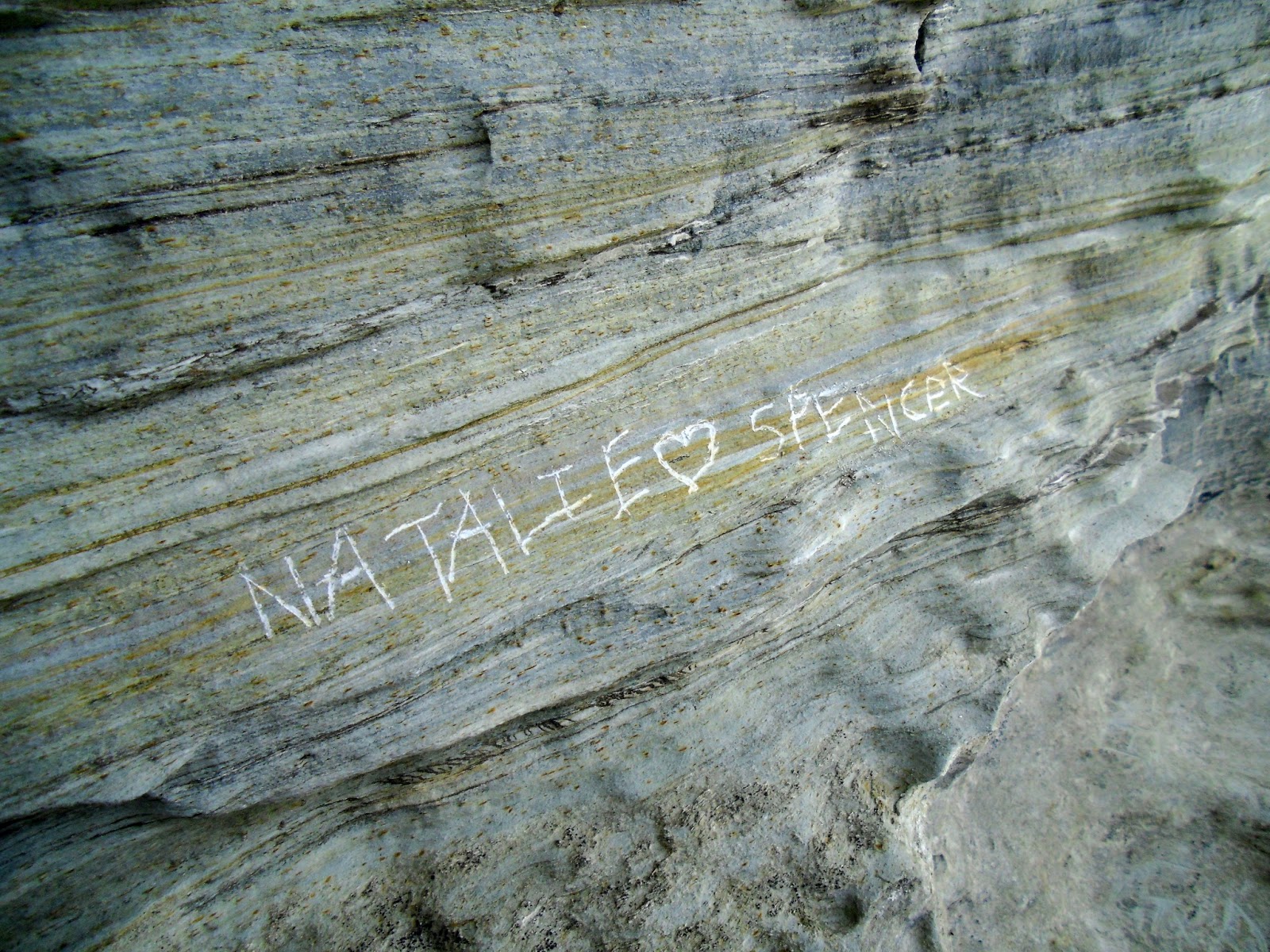
Hannah Thomas scratched Spencer's and my names into
the Ladies Window along the Jurassic Coast approaching Boscastle


-Natalie Cherie