Monday, June 10, 2013

The Stamp of Immortality: The Mortal Moment Part Two

Flying Kites in Tintagel
I'm back and officially online for the next ten days! This is because I just arrived in London which is absolutely fantastic and exciting. Our hostel is situated next to an Opera Garden so each evening we hear the sopranos and baritones singing as we write. It is quite excellent. Each day we'll so see a new site and we were even able to book tickets to the musical WICKED. I can't wait! So the past little while, when I've been gone from the online world has been tons of fun. I've been exploring the legends of King Arthur in Tintagel and singing with locals in the Wellington Hotel pub of Boscastle. I was even crazy enough to play some music on my guitar. It was pretty neat because they were so welcoming and even gave me a sandwich because I played. 

Cheryl was one singer who was kind of sassy and coy. She was absolutely delightful. She would act along to the ballad lyrics and make jokes to involve us as young adults. She was Scottish and before I left she came up to me, cupped my face in her soft, weathered hands and lightly kissed my cheek. Jack was the B and B owner and he was there playing his Mandolin-Banjo. He is a painter and the walls of his home are lined with beautiful oil paintings of the harbor. Also, he loves rock so as we sat looking through all of his collected items, statues, and photos there was classic rock in the background. His granddaughter's name is Genevieve and she was running around calling after the little dog Ollie who didn't like to stay put. It is honestly one of my favorite things to watch the everyday lives of people. I find it delightful and fascinating. I was even inspired to write a song about Genevieve so we'll see where that goes. 

The twisted trees in Stourhead Garden 
Soon after I climbed to the top of Salisbury Cathedral and was able to see the immense architecture which holds everything up, all weighing down on literally four feet of foundation. Incredible...pictures coming soon. :)

Apollo's Temple (the Pride and Prejudice rejection scene)
Then we removed our group to the Isle of Wight where we visited Queen Victoria's summer castle, Osbourne where she led her quiet family life away from the pressure of public life. It was really fun to see some more recent architecture, coming from the Victorian Era, but it was kind of mindblowing to realize that Osbourne's recent architecture was closer in age to our own Nation than the bulk of England's buildings. I also got to swim in the ocean for the first time at the Isle of Wight when a bunch of us went night swimming. It was rather cold but a total blast. 

Oh oh! And we were able to visit Stourhead which is where a few scenes were filmed from the newest Pride and Prejudice movie. It was a beautiful expanse of gardens and there was a very romantic feeling to the area. Everything was in bloom and the sun was shining. The grotto and other rock structures were super cool and the Romanesque statues were so lovely. On that note I don't think I've ever seen so many naked statues before, but alas. Anyway, it's been a wonderful time flying kites as the sun sets on the ocean, feeling like Anne of Green Gables while sitting in the blowing grasses on the cliffy shore, running around looking for wifi, and meeting local people like Cheryl, Jack or Genevieve. I even got some time to write and finish my essay. So here is the second part to my essay The Mortal Moment: Trekking the Pilgrimage of Existence. This is the last part title The Stamp of Immortality. Enjoy!

The Stamp of Immortality


North Germanic Sea
I remember this concept re-invoking my attention after a short conversation I’d had whilst walking a stormy beach. To my companion I had expressed that the ocean and the waves never grew old, their awe-inspiring effect always stunning as I looked out upon them. But she had heard something quite different.


It has always interested me how people can perceive two different experiences or meanings from one original source. Perhaps I will look into that later.


Anyway, though I had merely expressed awe at the stunning effect of the ocean my friend had heard only two words, “never ages.”  At that moment our conversation took quite a different turn as we began to analyze the endurance of nature, its means of existence, and what I will later define as the stamp of immortality.

Tintagel

Perhaps nature’s most stunning quality is it’s agelessness. No matter the time that passes, the lives the play out, or the generations that pass, nature never seems to yield. As an ever-constant companion this omnipresent existence has paralleled itself in our minds to God, resulting in the prevalent idea that nature is a consistent connection to the divine. This connection whether founded on the shared qualities of consistency, beauty, power, or endurance has served as a balm to those who have sought its repose.


The Jurassic Coast

But what is it that people find when escaping to the isolation of the wilderness? The capacity to endure and the agelessness of dormant energy buzzing through the life-blood of every plant is certainly to be found when entering the woods or walking along a beach. If one is religious, feeling a closeness to God is made vivid upon entering the hills. But these findings, though important as they symbolize the endurance of nature, simply answer the “what”? Perhaps more important is answering the “how.” How is it done? How is endurance, like slow plodding, achieved in such intricate beauty and sheer magnitude?

The “how” is what we titled as Nature’s means of existence. We began by dividing its contents into two categories. A plant expert or even just flower gardener, might call the categories the annual and the seasonal. I, as a writer, have learned to recognize the elements of landscape as the pillars and cycles. To be categorized as a pillar an element of nature must serve as a foundation immovable. Those the effects of time may erode or deface the efforts of such pillars their sheer attempts to remain attain them the timelessness upon which the fresh beauty of nature is built. Among this category stands the rocks, the cliffs, even the pebbles of the beach. Mountains, valleys, the oceans and the sky. For a time even the castles of medieval men may serve as a monument to the pillars. The waves which keep time by their which coordinate with the pull of the moon, or the sun which rises and sets along our horizons all become the pillars of immortal nature. 
Fountain Abbey's Ruins

Perhaps an easier to recognize those which the requirements are to simply remember the four elements of earth, air, water, and fire. It reminds me of meditation. Almost a year before I came to England I was taught to meditate by the elements. My fiance served as the storyteller, weaving smooth lines of prose that embodied the elemental imagination behind my closed eyes. Each breath was modified depending on which element we were emulating. Water was smooth and relaxed, earth steady and firm, fire was energized and powerful, and air was light and ethereal. Each was fulfilling in and of itself but when juxtaposed in contrast to each other became foundational, or the pillars, by which internal peace was achieved. This to me was when I first discovered the “how,” the means by which nature exists.


The South Cliffs of the Tintagel ruins

In the seconds category, that which cycles, one will find the plants that bloom and leaves that fall off of the trees, the rains and snows which fall only to dry or melt, and even the animals which are born, live, and die, soon returning to the land. The cycles, like the pillars, are fundamental to Nature’s means of existence but instead of adding the timeless effect of endurance they add the agelessness of constant rejuvenation. This rejuvenation or as I first heard in The Lion King’s “The Circle of Life” is what grants peace when simply submitting to the way of things. All are born, each has the opportunity to live, and all must die. The new will rise up, the old will pass away. Upon the aged footprints of one are the tried and tested footpaths of the other built. When coming to such peace in life, and indeed death, we too like Nature discover the way to exist meaningfully.

Though the how is perhaps most important for implementation, and the what for comprehension, it is when the two come together that self discovery is found. Self discovery may be considered the “why” of nature. But with no other reason than self discovery being a less-than-evocative title I decided that “The Stamp of Immortality” was a better explanation for the possible reason behind an individual’s turn towards nature.

It seems to be a trend that many individual’s turn to nature for isolation, inspiration, or repose. Even I seem to fit the mold, having laden myself with thousands of dollars worth of debt and flown thousands of miles, leaving behind my loved ones to find something more hardly knowing what it was I was searching for. But what is it that we all have in common, why the exodus, why the need for a pilgrimage to nature? W.G. Sebald made famous by his writings which detail lonely wanderings, isolated melancholy, and forlorn musing once said, “Like our bodies and like our desires, the machines we have devised are possessed of a heart which is slowly reduced to embers.” Ophelia, while singing of flowers and mourning their wilting leaves says, "There's rosemary, that's for remembrance. Pray you, love, remember. And there is pansies, that's for thoughts...There's a daisy. I would give you some violets, but they wither'd all when my father died. They say he made a good end."
 And even my friend and I, amidst small talk, found significance in the two words, “never ages.” Lying in common with each is the hope of life, the inevitability of death, and the stamp of immortality.


For Sebald nature may have served as the means by which to express his “enstrangement...with their (memory) mounting weight.” In The Rings of Saturn his English wanderings became the path of his repose, his own means of existence, his way to endure the bleakness, the grayness of life. Perhaps unlike many, Sebald wasn’t seeking personal immortality in reaction to a fear of death or a love of life, but rather reconciling himself to the immortal struggle of lonely minds. Such isolation and reconciliation with grief may be found in nature.

It surprises me how similar Shakespeare’s Ophelia is to an author like Sebald. Such words describing enstrangement, loss, struggle, and isolation previously used for Sebald, all make an accurate characterization for Ophelia’s turn to nature as well. But their remains one fundamental difference. Unlike W.G. Sebald, Ophelia not only finds in nature expression for inexpressible sorrow but also relief and escape from burden through death. In the play it is a matter of little dispute as to whether or not Ophelia’s death is suicide. Because she did not attempt to save herself, maybe due to her insanity, she was accounted responsible for her own death. Yet, while looking at her peaceful body I wondered if she was rendered unaware of her own distress through her perfect acceptance of the course of life and the way of death. Can this be immortality? Can accepting our eventual end implant our beings into the fabric of nature as our bodies will when embracing the dirt? Is this immortality?

A Pride and Prejudice moment!

When coming face to face with the dead Ophelia I experienced my own moment of mortality. My hands seemed to grow cold prematurely as I stared at her face and I found myself frightened. But now I am not afraid. The dispelling of my fear occurred after my own turn towards nature. By engaging in the tradition of humanity I tapped into the exodus to nature and the pilgrimage of existence. For me mortality and nature seem to unite while standing before the sublime. To stand on the edge of a precipice and recognize the possibility, this is the sublime. To stand in awe at the pillars and cycles, to be stunned by the endurance of nature, and to glimpse the stamp of immortality, this is the sublime. While in England I have found such places while climbing the steep slopes of Tintagel or hiking on the craggy cliff edge of the Jurassic Coast. In these moments I stand in peace not wondering whether I will ever live up to the legacy I hope to leave. In these moments I stand in relief, feeling satisfaction in the life I currently lead. In these moments I stand in amazement wondering how I might unite myself to the earth created by the hand of my God. In these moments I begin to write. And the trek continues as I search for the words of what it means to live and how to live. As I search for the words of how to die and what it means to remain as a voice upon the wind calling lonely souls to nature, I enter the pilgrimage of existence and perhaps for a moment suspend or rather embrace my own mortal moment.
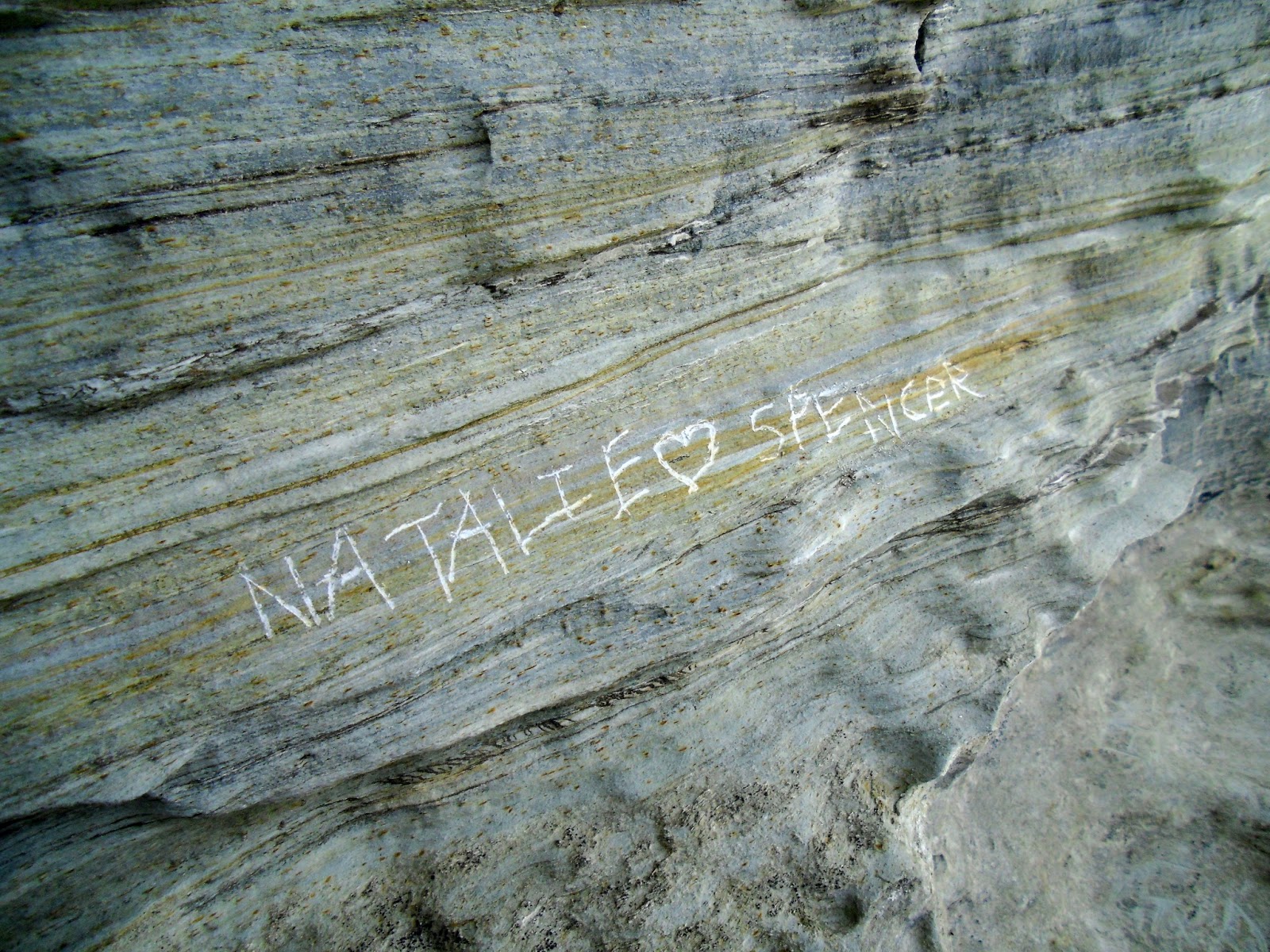
Hannah Thomas scratched Spencer's and my names into
the Ladies Window along the Jurassic Coast approaching Boscastle


-Natalie Cherie

Saturday, June 1, 2013

What Lies Beyond these Walls? (a project for two)

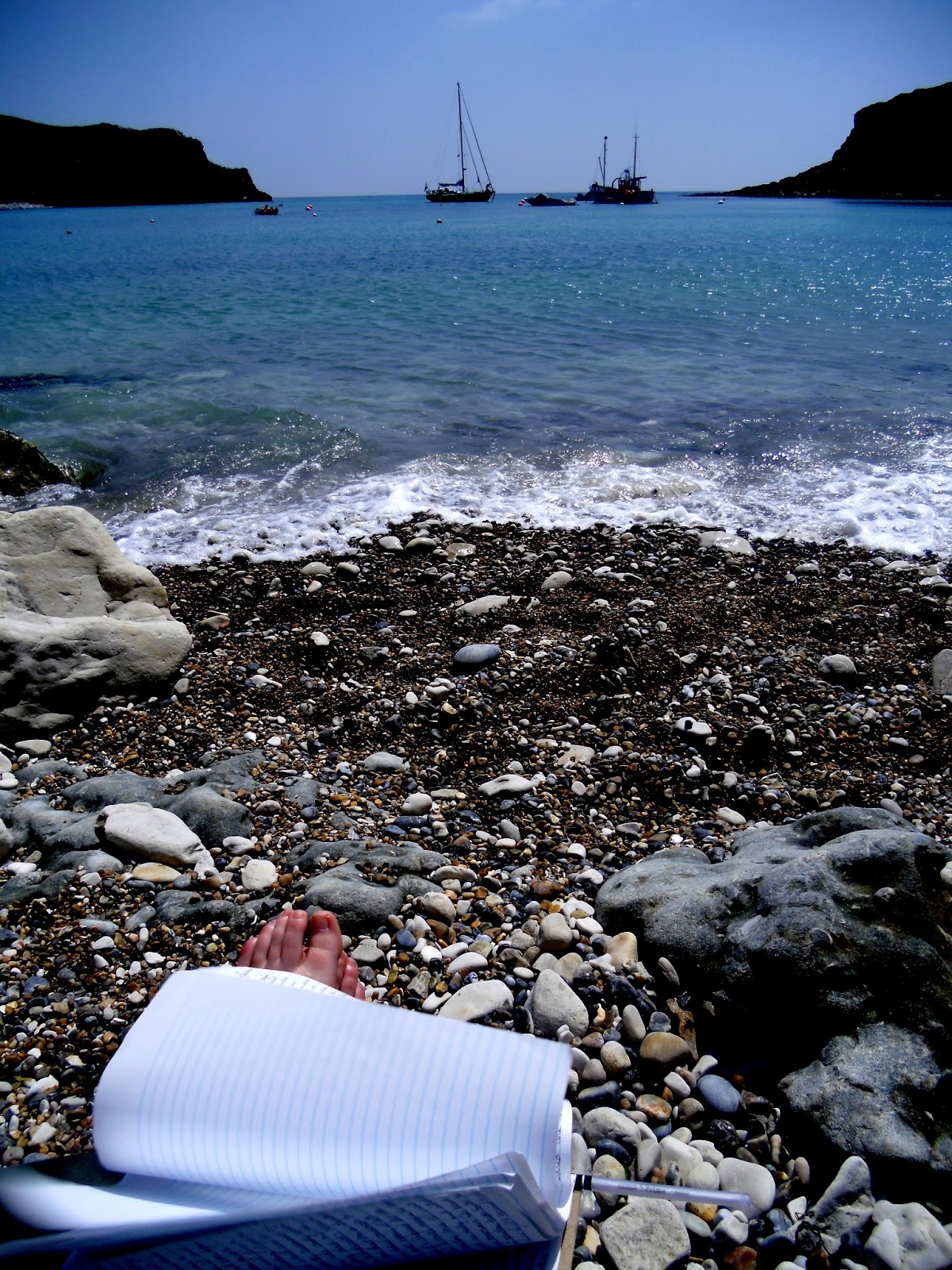
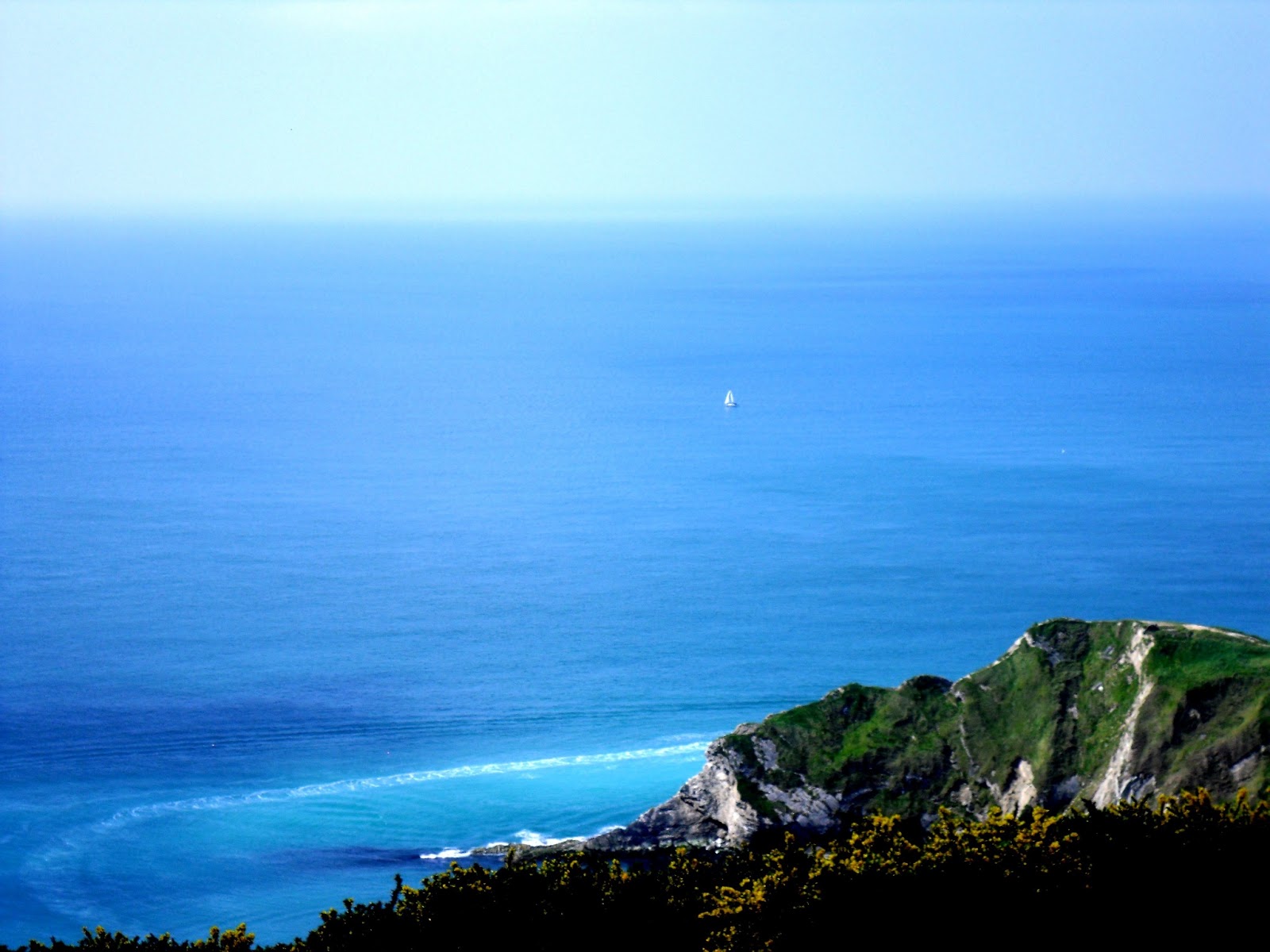
So over the past few days, I've been working on some little projects like my poem on Wales or this! This, being an assignment for two. Paige was my partner and our goal was to write one descriptive paragraph. After having done so, we'd give our paragraph to the other person and they'd write a paragraph of meaning, an essayistic interpretation. Mine focused on Lulworth Cove. The cove world-famous for geology and geomorphology is home to Durdle Door (a naturally occurring rock arch). It is also thought that the cove may have served as the inspiration for J.M. Barrie's Neverland. Paige's paragraph focuses on Tintern Abbey which is the source of inspiration for one of William Wordsworth's most famous poems. Anyway, both days (the day spent at the beach and the day when we read "Lines Composed a Few Miles Above Tintern Abbey" in Tintern Abbey) were fantastic! Oh, and at the cove, I saw the cutest little girl that looked exactly like the Coppertone Sunscreen Baby. She was super cute so I thought I'd mention it. Anyway, here goes!

Natalie:
The cove is a moment nearing paradise. All around, the craggy cliffs reach towards the sea and frame the water that rolls with the tide. The blueness of the sky reflects off the crystal water to create a seafoam blue approaching green which carries in the white bubbles that stir near my toes. All the shore is lined with pebbles and white-washed rocks some covered with green seaweed tendrils yet most clean, shining from their place. Out in the cove, the yachts and fishing boats rest, occasionally bobbing when a wave pulls in with power. Above the seagulls draw patterns in the sky not thinking of their landing place, but rather glorifying in their flight. The sun which glows across the landscape casts reflecting rays on every surface. In sunshine, the water glistens like a thousand flickering lights and the rocks shine as marble. All around the world is alive and one can only wonder what lies beyond these walls?

Paige:
Yet, this question seems too broad to even answer, for there will always be walls, whether you are standing within city gates or laying on a blanket in a lawn surrounded by a picket fence. When surrounded by these barriers we always seem to ask, "what lies beyond these walls?" Well, everything does. Beyond a fence lies a neighborhood, then a city with people, then a country and it continues until the universe is reached. We never seem to ask, "what lies within these walls?" Yet, we can never hope to answer the first question if we cannot answer the latter.

And for the second set:

Paige:
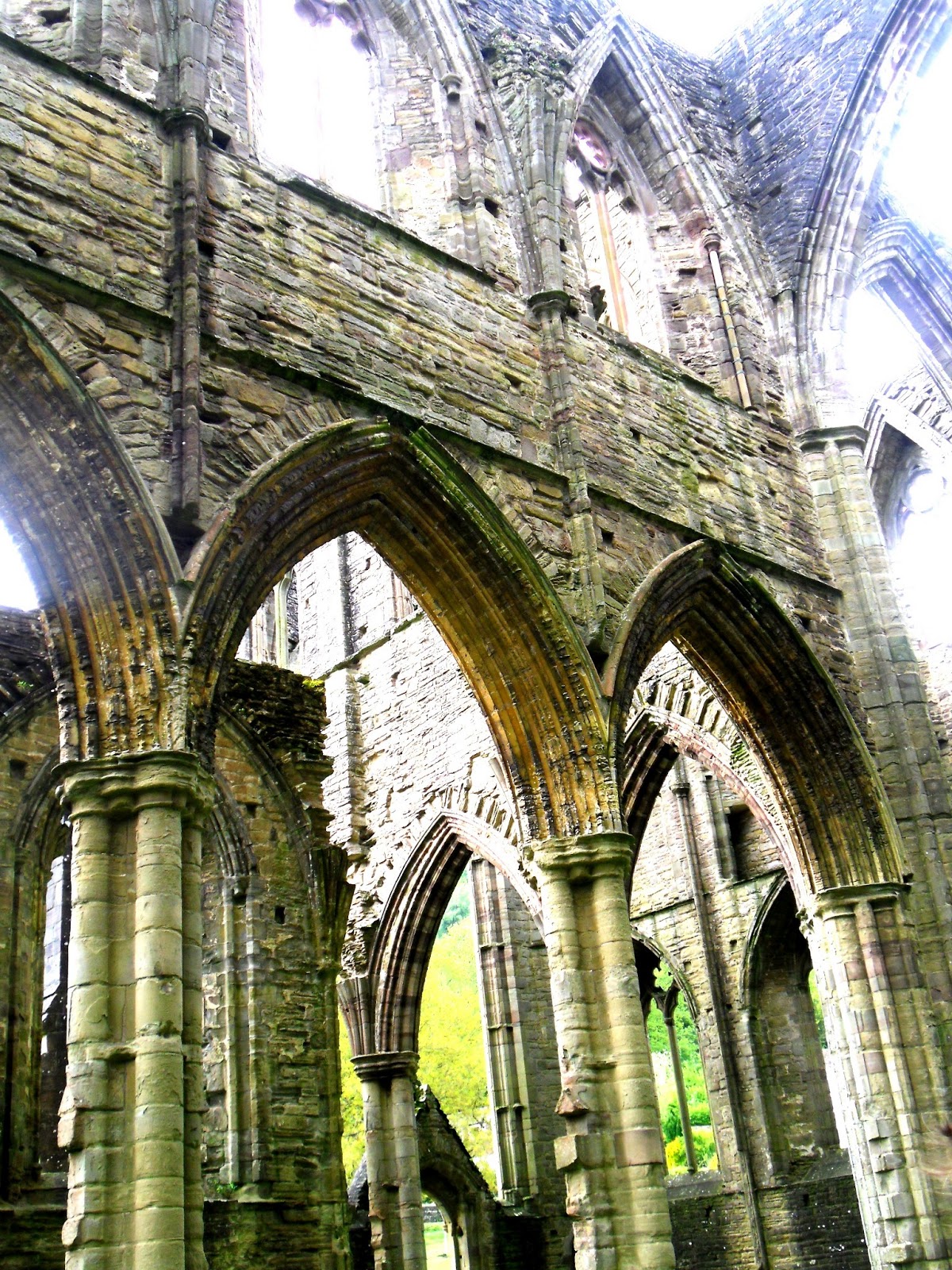
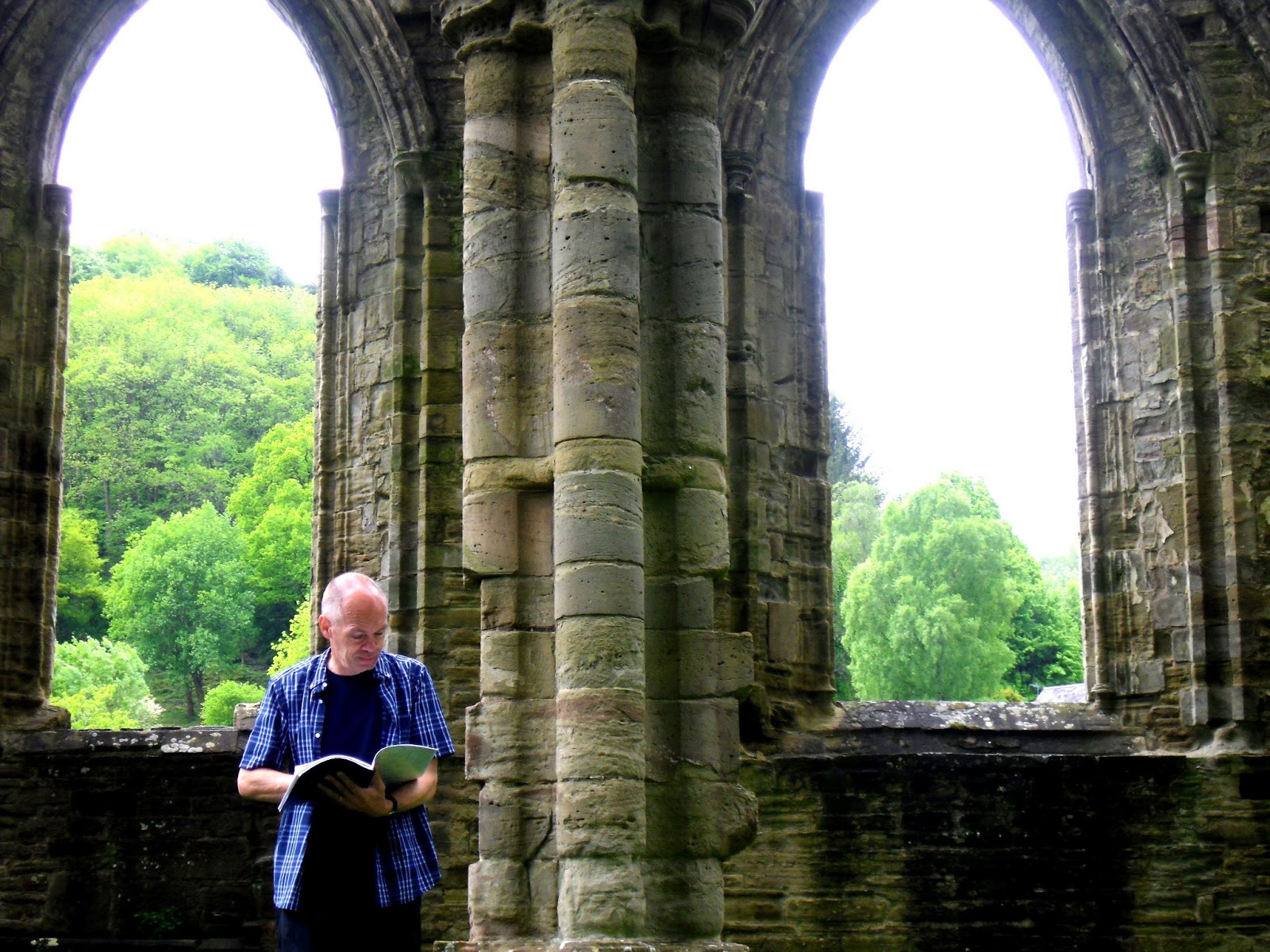
The walk turned from three miles to six which on a normal day would have been an annoyance. However, the soft green meadows surrounded by thick forest was a worthwhile setting. We reached the cobblestone town, winding past window shops and flower baskets. After rounding a corner I could see the poet's Abbey, the stone worn like the others I had seen. The outer view was grand but walking through the archways brought a greater sense of awe. The green, earthy floor scattered with daisies provided a striking contrast to the grayish-brown structure. The abbey seemed more massive at this angle. From the outside, the abbey seemed to have a roof. From the inside, the sky was the shelter.

Natalie:
It seems strange that a set of ruins or a green meadow can embody a change of perspective, yet that's exactly what had happened. What is it that moves us when a long hike becomes a pleasant trek or an old ruin a liberating edifice. I think it comes down to where we stand. A mathematician finds beauty in angles, a painter in contrasting perceptions. But as a writer, it all comes down to perspective. What are words but the representation of perspective, the mirror which reveals where we stand? When we stand in contemplation an arduous hike becomes worthwhile interaction with nature. When we stand in amazement the sky becomes the limitless bounds to the aged walls that seem to have forever stood. Much like a roofless abbey, our inspiration will always be dependent on our perspective.


-Natalie Cherie

Fy Cymru, Gwlad y Gân


Hello! I'm back once again and after a week of being without WiFi, my blog is about to get loaded with posts. That's a slight exaggeration but we're going for at least two or three. :) So the past week has been spent in different parts of Wales and England. This post focuses mainly on my feeling for Wales (via poetry) but I also visited the Roman Baths and the Jane Austen Museum in Bath, England, and St. Briavels Castle (the second most haunted castle in England), as well as Lulworth Cove. I'll tell you more about the cove in the next post. 

So just to start out with some pictures here are three entirely different captured moments of the week. The first is a beautiful piece of countryside in England as we hiked six miles to William Wordsworth's Tintern Abbey. 

The second is me on a travelator in Merthyr Tydfil, Wales. It's just like an escalator but with no steps! It's just a huge ramp and it's super cool. :) I'm not going to lie, Paige, Hannah, and I played on it, running up and down like we were five. Good times :) Also, Merthyr Tydfil was actually originally a mining town which I thought was cool. 

And finally, this last one is of the Roman Baths. Lining the terrace are statues of the Roman Emperors, including Hadrian (built Hadrian's Wall to keep out the "savage" celts), Julius Caesar, and Constantine. The water, now green, became so after the disintegration of the roof. The water flows from a natural spring and the Bath though great becomes even more significant in that it is also the Temple of Sulis Minerva. Sulis, a goddess of the natives became merged with the Roman Goddess Minerva after the Romans arrived. She is a goddess of wisdom and healing which seems appropriate due to the Bath's reputation of having restorative powers. What I found most impressive was that the pool is still intact. Though green the water is kept in the pool because it remains watertight, after almost 2,000 years, because of the immense craftsmanship of the lead workers who lined the pool. 

Anyway, I'm still working on the second half of my current essay so here's some light projects of mine in the meantime. Many of my ancestors on my mother's side are from Wales so I felt especially akin to the area so here is a poem I wrote about Wales. 
p.s. the translation and pronunciation are at the bottom. :)


Fy Cymru, Gwlad y Gân

The fairyland, thy place lies amongst purple flowers,
Which hover as wings along the mossy hills.
I tread lightly. My boots which carried me through Britain
Now contrast their dark and supple leather against the picturesque dell.


The mists which coast the Brecon Beacons 
And lay among enchanted tangled trees, 
All create this calm array of color 
Which glisten as the raindrops quietly cling 
To the petals of each tiny fairy flower, 
Or the pebbles which sink beneath my boots, 
As I glide along the pathway of the fairies 
And drink from the beauty of the view. 


The scene which looks just like a picture, 
Oil-painted, in yellow, purple, green, 
Or the smoke as it rises from a chimney 
Hidden beneath the treetops of these woods. 
The forest standing tall in strict formation, 
As I gaze out for miles and miles ahead 
Seem to sing out a long forgotten love song 
In remembrance of their resting sacred dead. 


What moves me in these tiny purple flowers, 
Which float above the grasses and the dew? 
Or the flocks which dot the lingering hillsides 
And graze upon the fairyland in Cymru? 
Oh move amongst thy sheep oh gentle Shepherd 
And tell me were you once my distant kin? 
And did you sing the strains of a sad Welsh love song, 
With the fairies as your only accompaniment? 


May it be that a home which never having seen,
Pulls the ties of my heart from this place?
Will the sweet songs of small purple flowers,
Keep my soul in their immortal, fairy'ed space?

Though I go I will ever wish to wander,
Ore the hills that I tread and nurtured long.
From this land to a love that's even dearer,
Unto the West, I will take with me this song.

May I float among the tops of the forest,
Oh, Cymru.
May I glide with the mist and the rain,
Gwlad y Gân.
And find rest in the fairy'ed, purple flowers,
Fy Cymru.
Home to me, Gwlad y Gân, Fy Cymru.


*Welsh Pronunciations and Translations
     Fy Cymru: V-ee Come-ree
     Gwlad y Gân: goo-thlad uh gahn
     Fy Cymru, Gwlad y Gân: My Wales, the land of song

-Natalie Cherie

Saturday, May 25, 2013

The Mortal Moment: Trekking the Pilgrimage of Existence

Addison's Walk
Hello again everyone! So currently I'm in Oxford which has been a blast and a personal check mark on my bucket list. I love J.R.R. Tolkien and C.S. Lewis though I'd have to admit that I'm more of a Lewis buff and  my little brother Tanner the Tolkien buff. Yesterday our Oxford tour was conducted by "Dashing Fred" (his real name is obviously just Fred but the nickname is very deserved). It's lucky that he was so energized and fun because the two hour tour was conducted almost entirely in the rain. But it was lovely.

The Lamp Post!
We got to see the door and lamp post that inspired C.S. Lewis' The Lion, the Witch, and the Wardrobe. That is probably what I would designate my most intense nerd moment of the day. We also stopped by Magdalen College where both Lewis and Tolkien taught. Today we actually went back and walked Addison's Walk where J.R.R. Tolkien and Hugo Dyson discussed the truth behind myths, eventually leading to the conversion of C.S. Lewis, an adamant atheist, to Christianity. As many may know, C.S. Lewis is one of the most influential, modern critic, writer, and essayist of Christianity. And it all began with a friendship between Tolkien and Lewis. So here are some pictures! 
The Door is carved with the lion that became Aslan
 and the gold figures are what on the side posts are what became Mr. Tumnus

The Garden Passage in Nash's Home
The Gardens in Elizabeth Nash's Home


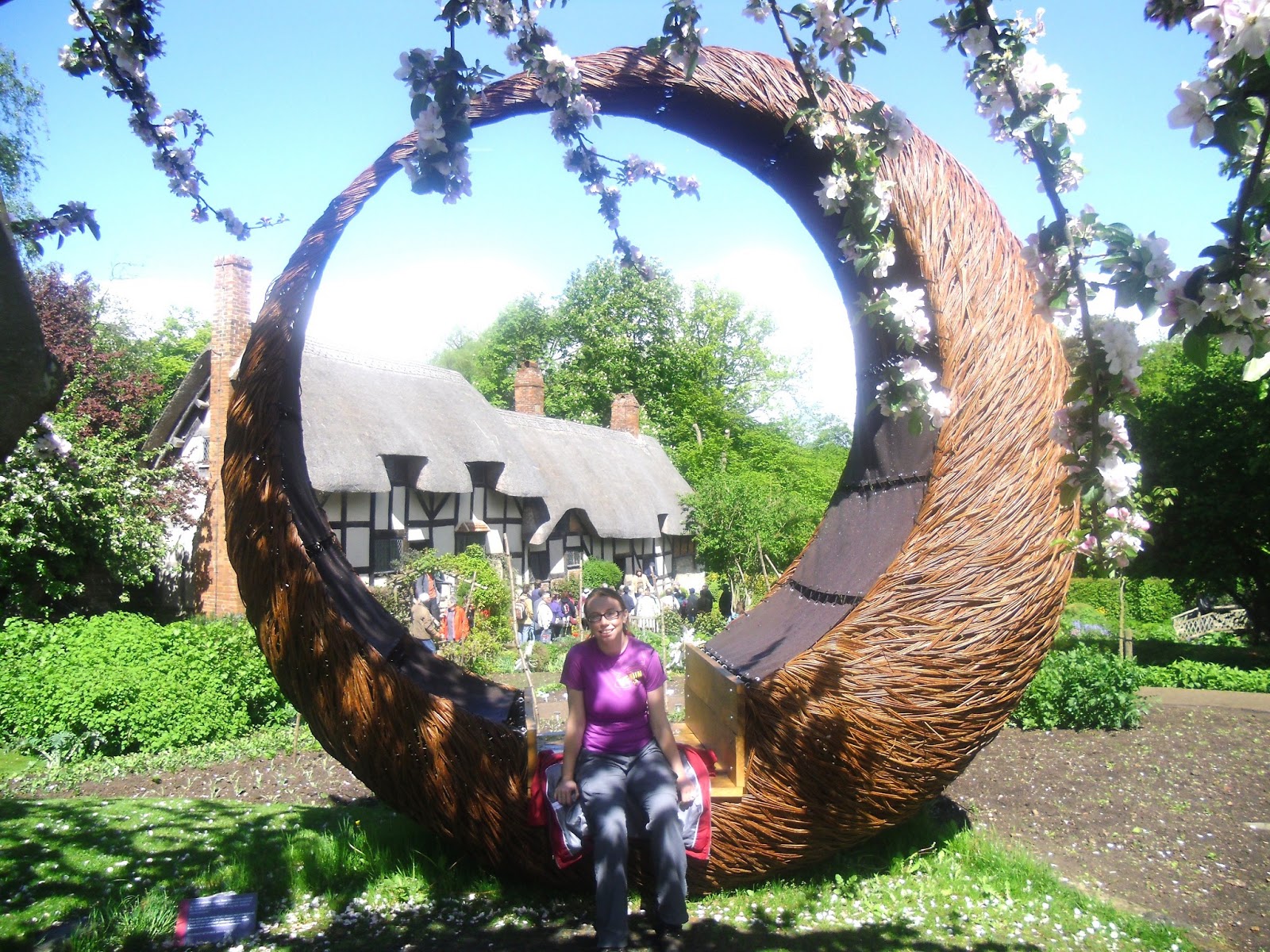
Anne Hathaway's Cottage
Before Oxford I spent a couple of days in Stratford upon Avon where we saw the Royal Shakespeare Company put on Hamlet, Titus Andronicus, and As You Like It. I didn't personally go to Titus Andronicus because of my weak stomach and all-to-good memory. We also took numerous tours through the homes of Shakespeare's daughter Suzanne, granddaughter Elizabeth, his father John, his mother's childhood farm, and his wife's cottage. The garden's were probably my favorite part of the homes, even though both were fantastic. 

Yay for Harry Potter Butterbeer!
Also there was a place in Stratford called Magic Alley and we got to try butterbeer there! It was really yummy but so so so sweet. Kind of a citrus and ginger lemonade with foam, it was delicious. 

The reed covering the leads to the woods
The woods next to Anne Hathaway's Cottage
Okay so I'm currently in the middle of my newest essay on the connections between mortality, pain, and nature. They all seem like random topics in relation to each other but I promise it will all come together. This is actually going to be one of my longer essays so I'm going to post it in installments. Here are the first two sections! Enjoy. 

The Mortal Moment
Trekking Through the Pilgrimage of Existence

Ophelia in RSC 2013 production of Hamlet

Recognizing My Own Mortality

Ophelia was lying dead on the stage. Man, she was so dead. Somewhere in my mind I’d created a strange division between those who were simply no longer moving and those who could never rise again. Though seemingly the same, as dead is dead, one seemed passively fading away, while the other symbolized the struggle to live and the stark contrast of being forbidden from life. Ophelia, still dressed in her wet wedding dress was bone white with a blank, startled stare, slender in her now ebbing beauty, and frightening as her energetic spirit was now stilled to silent dust. As I stared at her I grew more and more uncomfortable, willing her to move, wishing her to move. She never again did move. For the first moment in the 20 years of my existence I understood the state of my own mortality and the finality of death was stunning.


Sitting in a room amongst the ruins of Fountain Abbey
I have long been aware of the passage of time. It has been a concern of mine ever since I was five years old when I asked my mom where time went as we spent it. I remember wondering if I could save it. Maybe if I were really frugal it would last longer. I remember asking how it was that time moved so quickly only when I was having fun. I thought it was quite unfair. Somewhere along the lapse of 15 years I have learned that I cannot save up time and perceiving time as slow is not worth sacrificing the joy that makes time move quickly. It was always rather obvious that someday time would run out, someday the clock would stop ticking its endless rounds around the clock face, and through the glass the sands would run thin. But in the invincibility of youth I never thought I’d face that day. In 43 days I’ll be getting married, in two years I’ll be graduating with my BA in English and a minor in Editing, in a short time after that I will probably become a mother, in ten years I will be thirty, and the list goes on. For now, I have the time with which to live but one day I will be given the time with which to die. And in that moment I will die and lie still like Ophelia. In that moment I will return to nature.


The Garlic Bridge off the trail near Fountain Abbey
(the entire bridge path is a garden of wild garlic plants)
This moment of recognized mortality occurred in the Royal Shakespeare Company’s production of Hamlet in Stratford upon Avon, since I am currently residing in England for two months gaining experience in my English field of study. Much of my experiences have been centered around our constant movement through the cities and towns of England, Scotland, and Wales and more especially the hikes and walks that serve as our mode of transportation through the countryside. As I have been consistently surrounded by this countryside I have found myself deeply disappointed in how uninspired I have felt in reference to the nature, which I perhaps have overly romanticized. I have even, in certain moments of particular frustration, gone so far as to assert that nature cannot serve as a source of inspiration but rather only as a source for repose. I still believe this alternate role of nature to have validity, but upon receiving the opposite opinion in an email from my fiance I realized that I had ignored a very important side of what had become my one-sided coin. Though I believe the period of reflection granted by excursions into nature to be very important, it simply does not stand to claim that nature is unable to inspire. For somewhere, along a lengthy line of thought, I had realized that nature and flowers gave voice to Ophelia's sorrow, served as her executioner, and housed her remains. Ophelia's mortality, which now confronted me as my own eventual end, was inextricably linked to nature. And I have since become inspired to discover the source of such a connection. Therefore to some degree I have been mistaken in assuming that nature cannot inspire.

Trekking through the Rings of Saturn
W.G. Sebald

Shortly before coming to Stratford upon Avon we traced the footsteps of a the author W.G. Sebald and the twenty miles that inspired his book, The Rings of Saturn. 
W.G. Sebald understood well the reality of mortality, loneliness, the passage of time, and the connecting thread we may find in nature. growing up in Germany, Sebald was acquainted with accounts, photos, and thoughts of the Holocaust from an early age, leaving him undeniably altered. For some time his father was also absent, being a prisoner of war in World War II, during which time Sebald's closest male figure was his Grandfather. These occurrences teaching him of the fragility of men, the loss and absence of loved ones, and the age of those closest to him color much of his work, perhaps serving as his moment when he first faced his own mortality. 


Standing on the shoreline near Suffolk

The night before The Rings of Saturn hike we watched a film called Patience, gaining greater access to the mind of of W.G. Sebald and his turn towards nature, in preparation for our own turn towards nature. Now more than ever I wanted to find the inspiration within nature that the melancholy voices on the screen seemed to find so prominently no matter where they looked. I thought that if I could walk an "inspiring" enough place, or somewhere that particularly spoke to me then I would be able to tap into the message, then nature would show me its ability to inspire. I think I got it wrong. I've totally misunderstood the meaning of turning towards nature. As I walked the shoreline of the Germanic Sea, walking the twelve miles towards Suffolk had great capacity to be either monotonous or inspiring. I never thought to decided which. I simply assumed that each piece of nature had been designated one or the other, and I waited to discover which this spot would prove to be. The moment I changed my mind was subtle. It came to me while I was writing a letter to my fiance. I was listening to Patience and thinking of the words he'd written to me in an email. I had asked him to give me his opinion on the essays I had been writing, including my essay that claimed the inability of nature to inspire as I mentioned earlier. This is what he said:
The Woods near Anne Hathaway's Cottage
(Stratford upon Avon)
"I really liked your essays. Especially the one about seeking non-inspiration from sheep. I appreciate the opinion that  nature does not inspire, but I do disagree :) I think that nature inspires by being majestic. Our attempts to define and describe natural wonders is one way that nature proves its muse. I agree that nature can provide a place for the natural greatness within a person to be realized and that is another way nature inspires. I think nature can inspire by being an example or being evidence of something, just as sheep as evidence of how boring nature can be. Nature can also show great power or peace. Artists then take these and create new ideas and expressions. I think you took nature as a muse for just words, but I would contend that nature inspires other styles of art as well: paint, photograph, film, architecture. And I think that nature's best inspiration is being a type for truth. Because what else is mankind seeking to illuminate? Few people are actually seeking darkness or evil or falsehood. We seek truth and nature gives us a means by which to realize it. We call truth given by the Holy Ghost inspiration. Why not call nature's truths the same?
But that is just how I feel. And think. :) 

I love you darling. I have to hurry to work. Be safe. Do great things." 

As I thought about these words this phrase stood out to me in particular, "And I think that nature's best inspiration is being a type for truth. Because what else is mankind seeking to illuminate?...We seek truth and nature gives us a means by which to realize it...
Do great things." 

Walking in Magdalen College's Addison's Walk
(Oxford University; where Tolkien converted C.S. Lewis)
Do great things? What could I do? A type for truth? What truth? Each of these questions coursed through my mind as I stared down at a fresh page in what would become a letter to Spencer. I was incredibly focused on my calligraphy, hoping that some response to these questions would suddenly manifest itself to me as I pressed harder and harder on the tip of my pen. Before me haunting voices emanated from the screen, praising nature and Sebald's ability to tap into nature...wait! Sebald's ability...Sebald's ability, not nature's ability. And suddenly I understood. It was not for me to receive but rather to discover. It was me.
I’d been waiting for something in the Landscape to prove it’s worth to me. I seemed to have been waiting for some hidden cache of coded thoughts to make themselves known to me, and further to impress upon my mind, which perceived a vast expanse of loaded nothingness, the form of words. This, would have placed me as some heroic idealist who had dug out the existential secrets of the abstract formations we term nature, yet continually rely on as a concrete connection between our individual reality and communal identity. But this was not my role, to reap success off of the endurance of nature, forever waiting for the landscape to adapt its wild language to the simplistic notation of the words in my mind. I needed to instead mold my mind to the procession of signals which emitted in a wild and unknown time table. It is not Nature’s innate responsibility to inspire but rather to exist. It is the setting not the interpreter, and it is for me to graft myself in and take part of a mode of existing in which the perfection of the cycle is found. What is Truth but the pilgrimage of existence? The way in which we triumph or endure the catastrophe of eroding time while enjoying the desolation and eventual re-growth of sweet tranquility.

This is what may be found in Nature, the renewal which inspires in ways other than words.

And that is what I wrote to Spencer. In one moment I learned that a twelve mile hike along the Germanic Coast could be whatever I made it and anything I chose to find. 
-Natalie Cherie
Next Installment Coming Shortly . . .

Friday, May 17, 2013

My Adventure, Someone's Home: A reflection on the nature of belonging

At Wordsworth's home, Rydal Mount

I think it's time to write a letter. I don't think anyone would claim that letters are insignificant, especially to those that receive them. Unless, of course, the letter is one of tedious business or solicitation. But today the letter I want to write is apart of that category all recipients hold dear: the love letter. To make it even better . . . I got a calligraphy pen after practicing with a quill pen and inkwell in the Wordsworth Museum in Grasmere, England. Yes, it will probably have splotches and scratches but it will be the most legitimate love letter ever! Also, these pens leave ink stains on my right ring finger--and thumb and middle finger--and every other finger. Needless to say, I'm not a pro but hey, my life is still made. :) So as you all know, starting with my recent blog post, I've been writing a compilation of essays. As far as technicalities go, this one is supposed to reflect something that I've experienced here. So here goes! I hope you enjoy my stream of thoughts, but then again I guess that's why you're reading.


My Adventure, Someone's Home

Sometimes while I wander thoughts begin to form. Like dew drops on flowers or whispers on the wind, the task becomes a race to catch them so they may take hold in the soil of self-reflection before they slide away. Of late, my thoughts have been of home. Perhaps it is when one crosses the vast expanse of an ocean that a susceptibility to yearning for those left behind becomes more prominent. Perhaps not. But as I sit here in England I am filled with awe at that which I see and that which I do not. In such moments of contrast, one may begin to see clearly. John Ruskin once said, "Hundreds of people can talk for one who can think, but thousands can think for one who can see. To see clearly is poetry, prophecy, and religion--all in one." For me, in this moment, to see clearly was to understand the nature of home and belonging. To see clearly is the birthplace of thought as well as the first moments of true appreciation.

In front of the Edinburgh Castle Memorial for Soldiers
My moment began many years ago with a lack of feeling. Often having little regard for the tuggings of home, I've always felt that my path laid further distant, exploring the recesses of the globe and the dormant thoughts that laid untouched in such places. This, I thought, obviously excluded my home as a destination. And for many years I have had little reason to think otherwise until I took a particular walk on a particular day in a particular mood. You see, I was in the habit of "missing." Some may refer to this as homesickness, which is true. But, as I was not sick and I yearned for more than just my home I shall broaden my term from merely being homesick. Because for me what was missing was everything I did not have which related to my home and sense of belonging somewhere.

In front of Edinburgh Castle
Well, I was thoroughly entrenched in the "habit of missing" when four days ago I decided to go walking down the cobblestone streets of Keswick. All around a solitary busy-ness prevailed as I waited for the first drops of an inevitable rain to fall and further dampen the already overcast scene. All forms of life seemed to move in a quick-paced plodding as shops were visited, dogs walked, and jackets pulled tighter in a continual bustle. I felt fairly apart of my surrounding, except my lacking a dog, yet in truth, I was as mentally distant and those that I longed for. Until a little girl passed by. No more than eight or nine, she rode a little purple scooter, in a little school uniform, with a little hole at the knee in her stockings. She was humming. As she passed by I realized, for perhaps the first time, that these streets which constituted my adventure were her home. As school let out more children filled the streets, rag-tag in there peeled off uniform pieces, each headed to their own home. Even in that moment, I felt a significance to my discovery and for the first time, I felt as though I saw clearly.

Now I sit in a comfortable chair in front of a flower and seashell filled fireplace in John Ruskin's home. It is called Brantwood. Every piece sits in beautiful preservation creating an ornate jigsaw puzzle of the ever-flowing thoughts of Ruskin's immense mind. To sit in such company seemed to qualify as a quiet sort of adventure, once again, far from home. And then I heard the piano. My thoughts quickly slid home as the melody of the keys and the familiarity of its sound touched my heart and mind. As I was thinking of my home it quietly dawned on me that this too was someone else's home. These piano keys, now awoken, were once played by those who moved, breathed, and lived in this place, their home. It was yet again another home which I had constituted my adventure.

Just chilling with hot cocoa in our first hostel
It makes me think of my first tea party in England. While sitting with my little friends Sarah and Dani and speaking in our attempt at a British accent I began a conversation by asking them if they'd had an adventure that day. To their sadness they told me that they had done nothing that day, therefore having no adventures. In a whisper, I quietly told them that "every day has an adventure in it, no matter where you are or what you are doing. Even if it is just your thoughts, anything can be an adventure." As their little eyes widened at this sudden revelation they began to review their day to find their own adventures that they had only just missed. And now as I sit here I wonder how many times we, lost in the sea of our own expectations, miss the moments that are happening all around us. I wonder as I walk the streets of York, Edinburgh, or Keswick if the people that swirl around me, who live maybe five or ten minutes walk away from this daily swirl their everyday life, realize that what they consider their home I consider to be my adventure. And I wonder further, how many times I've walked the paths and roads I know too well assuming that my home is only that. How many shoulders have I bumped or people seen that are on their own adventure in a place I've reduced to "just a home."
A view of Edinburgh from Edinburgh Castle
(the castle which acted as home and defense of home for thousands of years)

A daily street performer
Down The Royal Mile in Edinburgh, Scotland
In every place that is "just someone's home" history can be found. Lives have been lived and every day people still walk the streets carrying on. The traces of their beings leave a remarkable adventure as I sit contemplating and hoping to understand them. In every place that is "just someone's home" immense amounts of beauty is etched into the age-old landscape, imprinted by the elements of existence. Ruins and monuments, gardens and caverns, mountains and lakes, footpaths and trails. In every place that is "just someone's home" unique talent created by unique people can be found. Street performers, shop owners, dog walkers, strangers or friends, those going to work, those going on a walk. Young men carrying guitars, old men playing bagpipes. Each person has a story and the story they've created is the finely designed webbing that connects the elements of their home. And when I step in hoping to find an adventure I simply catch a snapshot of a life, a history, a home.

In every adventure I experience I find flowers worth pressing or rocks worth collecting. There will always be a plaque worth reading or a site worth seeing. I fully expect that the human race will still create people worth talking to, watching, hearing, and sitting with. Each of these elements, when examined in its whole, reflects the nature of home and belonging. Yet it is these same elements when captured in a snapshot form the makings of an adventure. They are one in the same, not to be separated but rather appreciated when seen clearly. They stand side by side yet also shed further beauty when juxtaposed in contrast to each other.

A local woman walking the beach in St. Andrews, Scotland
As I've come to understand this concept through my everyday experiences I've found that while my missing has not necessarily ebbed, it has become a pleasant reminder of the home I have and the homes I'm discovering here. It reminds me to be grateful for the adventures I'm having while allowing me to look forward to the adventures I will have upon my return home. It has given me a powerful sense of belonging because no matter where I am I may recognize the objects that fuse together to create my sense of home. Like listening to piano keys, or watching children play, certain books, or plants, or even a treasured letter and email.


In the garden's of Beatrix Potter's Home
In coming to England, it no longer surprises me to hear the innumerable songs dedicated to going home and the beauty found there. Under-appreciating one's home is not a problem for only a few and many never find fulfillment in the simple lives and those happenings that create their sense of belonging. Even so, I also sympathize with those who feel the yearning to search the corners of the earth and trace the steps of those who've existed there. There is inherent beauty in new sights, new sounds, and new tastes which can never be underestimated. But that is why the contrast is so lovely. To be home and to thoroughly enjoy your time there can be a wonderful adventure. To travel and to thoroughly enjoy your opportunity can be a wonderful adventure. Much like the way we bring our travels home with us through souvenirs, trinkets, postcards, and photographs we can, when found in the "habit of missing" bring home to our travels by recognizing and noticing the threads and remembrances that form our sense of belonging. In this way every stage of a journey can be fulfilling: being home, being abroad, and returning again. Maybe most fulfilling, is the realization that no matter what adventure lies in store or where it may be there will always be a new and exciting world to explore. And, if lucky enough to explore it one can realize and appreciate the home they have worth returning to, worth missing, and the people left behind who are worth thinking of and seeing again.

And that is what I found while listening to a piano in John Ruskin's home, having a little tea party in Earby, or seeing a little girl with a little hole in her stocking riding home on her little scooter through the streets of Keswick; I found the moment in which I first saw clearly. Finding that this world is composed of not just adventures, but homes. And no matter where I walk, no matter where I go I will be experiencing the beauty of someone's home. The history, the people, the landscape. Each part of the journey may be enjoyed and sometimes finding one's own nature of belonging first requires the "habit of missing"and is the prerequisite to the balm of appreciation.

Shoshone Falls near my home in Twin Falls, Idaho
right before Spencer asked my parents blessing in proposing to me.
(with my finance Spencer and little brother Jason)
As I sit here in England, moving from town to town as a traveling dot on a map, I now wonder who is exploring my own home. I wonder if they could be from here, as though we had just switched spots. I wonder what we would say if we could sit down and share first impressions and long time stories. My adventure, someone's home. My home, someone's adventure. Maybe someday I could tell that person of this instance in which I traveled, hiking across the United Kingdom. Tell them my love for England, Scotland, and Wales or maybe even the town they grew up in. Maybe someday I could ask them how they felt towards my home, the home I once thought so insignificant. Do the green and golden fields of wheat, alfalfa, and corn move them during the harvest days of Autumn? Do the mists from the Falls dampen their eyelashes as they have mine? Or did they lose their breath while looking over the edge of the Perrine Bridge over the Canyon? For now, I can only wonder and enjoy their home as they enjoy mine. But I hope they love it as I have and that my home is proving an adventure. Because now that I think about it, my home has given me the adventure of a lifetime, literally.

-Natalie Cherie

Thursday, May 16, 2013

The Honeysuckle Bush


So after my last post which could be interpreted as me bashing the uninspiring landscape, I'd like to share a little bit of my nature-loving side. For example, I'm an incessant flower picker. Sorry lovely gardens! But I love pressing flowers.

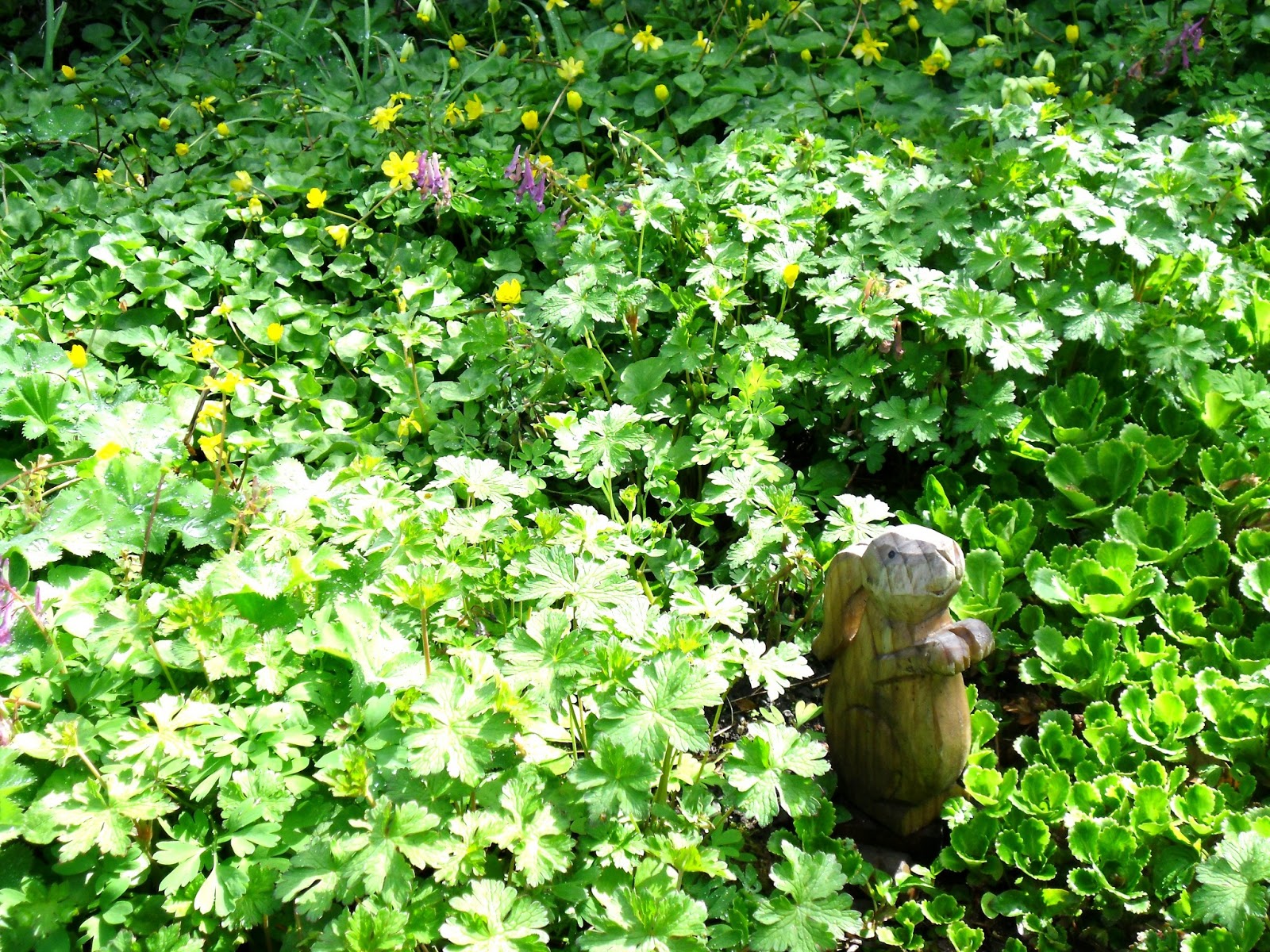
Also, I like taking pictures of nature, for instance, these pictures of flowers from Wordsworth's garden or this cute bunny in Beatrix Potter's garden. Anyway, there is a little proof for you. :)

So anyway, Dan (my other director) is our Romantic and Literature Professor while Pat is the Essayist and Travel Writer. Anyway, Dan is very very passionate and he loves bringing us into the world he adores. The other day he did this by having us write Wordsworthian poems. Once upon a time Wordsworth, upon the urging of his friend Coleridge, wrote down his personal process in writing a poem. So  Dan shared that process with us and gave us 20 minutes to write whatever came to mind. After the time ran out we each shared and snapped for each other and felt validated. It was great. The main thing we were supposed to do was go far back into our childhood and make the setting Nature. So I wrote an entire ten stanza poem in the 20 minutes only to realize that it wasn't set in nature. So in five minutes I scribbled down an entirely new idea and finished as it became my turn. So here is my spur of the moment poem. Enjoy.


The Honeysuckle Bush

I remember we'd hide among the honeysuckles,
Licking the sugar-coated dew.
It was our magical escape.

It was always warm when we'd go there,
In a few more ways than one.
But that is no matter.

For our honeysuckle bush was our magical land,
where leaves became teacups.
My sister had a good imagination.

But I could never quite forget the crying,
Of my mom and daddy inside.
I wish they had a honeysuckle bush too.


-Natalie Cherie