Friday, January 30, 2015

Speaking with God: Brief Personal Essays

Inner Struggle Essay

Photo by Natalie Cherie Campbell

Standing on a sidewalk I was stopped at a fork in the path. Instinctively I looked down the right path to my apartment window. My friends would be waiting, including the man I was dating. Without hesitation, I began to walk down the left path. Soon enough, as I’d felt to be true, Spencer ran up behind me, holding my hand. Through his eyes, I saw his soul sigh, and we kept walking.

Opening my eyes, I waited for the dreams to seep from my memory. I was accustomed to feeling forgotten dreams flee the daylight because I never remembered my dreams. But this morning was different: the dream didn’t leave. I had known Spencer for six months. We were folk dancers, and I lived for the moments when we danced together, talked together, laughed together, my feet burning with energy. But I also knew that he loved me and that I could easily love him if I let myself. So I didn’t let myself, instead choosing to spare with my conscious in an endless dance of self-denial as I remembered a priesthood blessing that told me "I'd know my future husband when I met him." Sometimes I decided that if Spencer was "the one" then he’d just have to wait. Sometimes I decided that God would have to fix my fear of marriage before I did anything. And sometimes I would dream. In the quiet moments of the night, when fear had gone to sleep, I began to dream honestly and refusing to let me forget, my dreams started to become a reality.

Scripture Essay

Photo by Dee West
In the summer of 2012, I would often sit on my roof, gazing up at God through speckled sunlight and leafy boughs. We would often talk, God and I; I would ask the questions and He would give answers. One day I climbed up onto roof from the side porch gap and lowered my head, shoulders sagging with repetitive weariness. I felt inadequate, frightened. I had received an email from Jerusalem, it was Spencer’s day to write, and he’s told me of his plans to work for the CIA. So I’d fled to my roof instead of arguing with mom over the wisdom of me loving a boy with such dangerous career goals. Feeling the warm shingles with my toes, I laid on my back, stared at God and began to speak:

“How is it done?” I paused as a bird flew from its nest. “God, how is it done, that you take such small people, move us so far, and use only those two actions to fuel your work? How?”

I sat quietly, waited, and began to speak. True to form, His answer emerged, simultaneous with the sound of my vocal cords. “By small and simple things, are great things brought to pass . . .”

Bombs bloom and poppies litter,
In realities where children shiver
From breath of hate and strain of woe
To such places my trusted go.
The small and simple are infinite,
When bringing with them the Omnipotent.

Wilderness Essay

Photo by Natalie Cherie Campbell
We were lost and it was my fault. I had gotten 25 people lost in a lush green wilderness of English footpaths. I’d spent the past month hiking through different parts of the United Kingdom with my study abroad group. On this particular day, we were trying to get to the London Temple because having gotten my endowments a month earlier, I had requested we go. Doing my best to book rail tickets, plan bus trips, and minimize walking, since my director didn’t want to, I thought I’d done a pretty good job until the bus didn’t arrive and we were left stranded in a small town a few miles away from the temple, ignorant of which way the temple even was.

“We could have been visiting tourist spots.”
“This is such a waste.”
“I didn’t want to come anyway.”
“So much for that plan.”

The words swirled around me like bee stings. Tears began to coat the stingers as each drop slid down my chin. “Heavenly Father,” I prayed, “please just help me find the Temple.” The gravel near my feet crunched as a tire filled my peripheral vision. Looking up, a silver passenger van had filled the road in front of our pathetic band of walkers, and a man in a white shirt and tie with silver tipped hair got out.

“Are you people looking for the temple?” he asked casually.

I was dumbfounded. As our director arranged to have our group driven to the temple in shifts, I got into the car. I was silent as everyone filled the air with thanks. The gentleman simply replied,
              
“Don’t thank me, I was just working in the temple when I was prompted that a group of lost brothers and sisters was looking for our temple and wouldn’t find it if I didn’t go and find them.”

As we drove away from our wilderness of English footpaths, I bowed my head once again, “Thank you for finding me Heavenly Father.”

~Natalie Cherie

Friday, January 16, 2015

Only let me be something: A Tree Grows in Brooklyn

Photo by Erin M
There have been many moments whilst reading literature that I have stopped, stunned at a phrase that seems so simple but writes truth so perfectly. One such moment was while I was reading A Tree Grows in Brooklyn by Betty Smith. Following the childhood of Francie, a studious young girl who escapes her alcoholic, poverty-stricken home life through books, A Tree Grows in Brooklyn would often move me with small, profound ideas. While sitting in the passenger seat of my car on a hot day, I was reading while my husband was driving, waiting for me to tell him the next passage that was too good to be left unspoken. 

Currently suffering from a bout of depression, I look up at Spencer and say, "Listen to this: 'Dear God,' she prayed, 'let me be something every minute of every hour of my life. Let me be gay; let me be sad. Let me be cold; let me be warm. Let me be hungry . . . have too much to eat. Let me be ragged or well dressed. Let me be sincere—be deceitful. Let me be truthful; let me be a liar. Let me be honorable and let me sin. Only let me be something every blessed minute. And when I sleep, let me dream all the time so that not one little piece of living is ever lost." 

When I finished Spencer, who has also suffered from depression, breathed deeply, saying nothing. It had been said. We were glad in that moment to live any moment because at least that moment included life itself. 


Other spiritual experiences with literature include:
  • Understanding happiness while reading the first lines of Anna Karenina: "All happy families are alike; each unhappy family is unhappy in its own way."
  •  Feeling the vast intricacies of nature, and the lonely fullness of my identity within nature while reading The Rings of Saturn. I may be an individual, and I may even be alone sometimes, but I exist within the far expanses of a beautiful eternity.
  • Experiencing the palpable reality of sin and redemption in The Rime of the Ancient Mariner.
  • Listening to the voice of Death as the narrator of The Book Thief.
  • Reading the accounts of Elie Wiesel's Night and Viktor Frankl's Man's Search for Meaning, in comparison to each other as a study of suffering and either losing or finding God when there is no balm in Gilead. 
  • Listening to my husband stand up and recite the poem "I Don't Care".
  • Reading "Rabbi Ben Ezra" by Robert Browning with my husband the night he proposed to me
~Natalie Cherie

Saturday, January 10, 2015

Discovering God in Narnia

Photo by Davemc500hats
I received my first copy of The Chronicles of Narnia when I was eight years old. The black cover held a stunning gold lion, who lived in the embossed cover, and while staring at its eyes I knew that The Chronicles of Narnia was going to be memorable. 

Looking back on those Narnian hours, I can now say that, outside of scripture, Narnia was the first place I had discovered God within literature. Beginning with The Magician's Nephew I found a creation story; moving to The Lion, the Witch, and the Wardrobe I found the atonement and resurrection. The Last Battle is eschatology in a children's story, and the allegories continue. 

As a child, these allegorical connections were thrilling and enchanting. I felt I had discovered a secret tale of a bygone land, woven with truths that must make God real. So I kept reading. To my young self, reading became the chance to unlock ideas and unseen realities that helped me understand the abstraction of divinity and the dichotomy of good and evil. When placed within the fantastic realm of lions, children, fauns, and witches, my faith became simple: God was real because if he wasn't then we couldn't have stories like The Chronicles of Narnia.

And Aslan is just one example of how literature can help us come to know God. As Edmund asked, "Are-are you there too, Sir?" said Edmund.
"I am," said Aslan. "But there I have another name. You must learn to know me by that name. This was the very reason why you were brought to Narnia, that by knowing me here for a little, you may know me better there." 

How lucky that I discovered God in Narnia because it is trueby knowing Aslan there, I came to know God better here. 

~Natalie Cherie

Wednesday, September 3, 2014

A Bird Must Have Strong Wings: The Awakening by Kate Chopin


“The bird that would soar above the level plain of tradition and prejudice must have strong wings. It is a sad spectacle to see the weaklings bruised, exhausted, fluttering back to earth.” 

These are probably the most beautiful lines of Kate Chopin's novel The Awakening.

So I'm going to approach this novel very differently from the first two. I have fewer opinions and less analysis. This is because of a few things:

1. I found Edna's character entirely unengaging.
2. I ardently disagreed with Edna's actions in response to her awakening.
3. Regardless, this novel deserves thought and discussion because the message and experience cannot be ignored.

When The Awakening was first published in 1899 it was not received well. It avoided a direct ban but was heavily censored due to Edna's choices which aggravated the established gender roles in society as well as exposed the very real existence of female sexuality. In short, our little, listless, Laodicean Edna created quite a stir with her emotional, mental, and physical abandonment of her husband, her occasional indifference to her children, her scandalous sexual liaison with Arobin, and her emotional infidelity with Robert Lebrun. The last of which resulted in her suicide. 

So what was the message? That female nonconformity results in unrest, unhappiness, and drowning in the Gulf of Mexico? Well, I suppose that's one take away, but certainly not the one Kate Chopin intended. Instead, this novel is heralded as one of the first truly feminist novels. This means the message lies within Edna's secretively common experience, making her the victim of an existence smothered by societal expectations. 

Before I continue with the alternative format I want to create some quick parallels in the novel's characterizations. So Edna is obviously the main figure, originally an ideal woman, wife, and mother who then awakens with life, passion, longing, and dissatisfaction. Mademoiselle Reisz is a recitalist who deeply touches Edna. Though isolated and often unpleasant, Mademoiselle Reisz is independent, perhaps even a representation of Edna's desire to be so as well. Adele Ratignolle is a doting and devoted wife and mother who gives consistent warning to Edna as well as Robert. She may also represent what women were expected to be: the ideal mother and wife who found fulfillment in others fulfillment. Robert is obviously the catalyst to Edna's awakening, and he also serves as the face to the qualities she sees lacking in her marriage. Whereas Arobin seems to be Edna's form of expression and rebellion.

Okay. I have selected some of my favorite quotes from the novel. (If there is one thing about this book it would have to be its style. It is written beautifully.) I will also offer some questions which will hopefully allow us all to ponder the messages behind Edna's awakening.

“Even as a child, she had lived her own small life within herself. At a very early period, she had apprehended instinctively the dual life - that outward existence which conforms, the inward life which questions.”
  • What necessitated the dual life for Edna? Was it expectation, propriety, class, etc?
  • Does our current society necessitate a dual life?
"He could see plainly that she was not herself. That is, he could not see that she was becoming herself and daily casting aside that fictitious self which we assume like a garment with which to appear before the world."
  • The "he" is Edna's husband. (Just for your information and contextual understanding.)
  • This seems to be the definition of an "awakening." Edna's awakening was definitively sexual and independence-seeking. This isn't necessarily always the case, so was Edna's awakening a result of that which she had been deprived of? Or was it a natural reflection of her personality? Both?
  • If the awakening is a response to a deprivation of the passions of life and personal sense of fulfillment then must an awakening always react like the swing of a pendulum? 
“Edna began to feel like one who awakens gradually out of a dream, a delicious, grotesque, impossible dream, to feel again the realities pressing into her soul.” 
  • Could Edna have confronted her awakening, her desires, and her "dream," while still maintaining a functioning and respectable place in society? 
  • Just as a side note, this quote could function well as Edna's unlabeled understanding of oppression.
"I would give up the unessential; I would give up my money, I would give up my life for my children; but I wouldn't give myself. I can't make it more clear; it's only something I am beginning to comprehend, which is revealing itself to me."
  • Do you agree with Edna's categorization of what is unessential?
  • She leaves the only truly essential thing as herself, her being. Is this selfish? Assertive? Natural? Healthy?
  • What do you think she means when she says, "but I wouldn't give myself"?
  • It seems that she has drawn a difference between giving her life and giving herself. What do you think the difference is?
  • Are the phrases "to give of yourself" and "to give yourself" intrinsically different in meaning?

“But the beginning of things, of a world especially, is necessarily vague, chaotic, and exceedingly disturbing. How few of us ever emerge from such beginning! How many souls perish in its tumult! The voice of the sea is seductive; never ceasing, whispering, clamoring, murmuring, inviting the soul to wander for a spell in abysses of solitude; to lose itself in mazes of inward contemplation. The voice of the sea speaks to the soul. The touch of the sea is sensuous, enfolding the body in its soft, close embrace.”
  • This is right before Edna drowns herself in the Gulf of Mexico. Earlier in the summer, Edna had finally learned to swim and reveled in the self-assurance and power of it. Does Edna's method of suicide a representation of her last act of independence? Or was she simply being morbidly romantic in dying where she was awakened by Robert? Both, or maybe more?
  • Much like the first quote of a bird needing strong wings, do you believe that Edna could have been successful in building a world she could abide in? Was she doomed to "perish in its tumult" from the beginning? 
"But whatever came, she had resolved never again to belong to another than herself."

-Natalie Cherie

Wednesday, August 27, 2014

Battle of the Sexes: Love's Labours Lost by William Shakespeare


Hello,
A second week of reading has come and gone! Let's launch right in. So first thoughts . . .

It doesn't end with marriage! o.O What?!?!

How odd . . .

Love's Labours Lost is one of Shakespeare's truly original plays. For a comedy, it seems relatively standard at first. Sexual tension, boys vs. girls wit, courting, misunderstandings, strategies discovered and foiled, the works. But There are a few key points that make Love's Labours Lost quite unique.

The Opening Circumstance

We'll begin with something simple, yet important. The opening circumstance. King Ferdinand and his three companions Biron, Longueville, and Dumaine have all sworn off women (Biron unwillingly) so that they can study in the Greek philosopher fashion for a short (or long, depends on when you ask and how in love they are) years. Even Though this may not seem like a big deal, it puts the men in a spot for certain ridicule as the King must soon welcome the Princess of France. Over the course of three years, (in this case sooner rather than later) a circumstance would have arisen which would force the king to be neglectful because of his slightly misogynistic oath. So, no matter what decision is made, he will either cross his word by breaking his oath or be neglectful and petty in his treatment of women, because of it. Also, most of the play takes place outside, which is traditionally symbolic of freedom, and sexual tension. So take a wild guess with this plays plot.


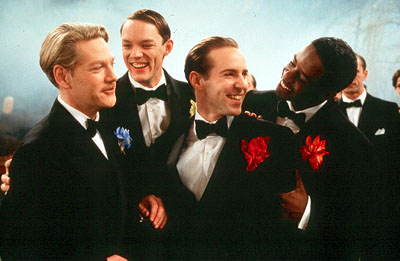
                                                                                     This is Biron . . .
Class Distinction

Shakespeare writes Love's Labours Lost with an interesting back and forth narrative, which jumps between two parties till they are brought into the same space at the end. The division lies along a class distinction. In one group is the King and his lords who are attempting to court the Princess and her ladies. In the other group are Costard (a crude clown), Armado (a Spanish braggart) and Mote (his page), and Jaquenetta, a "wench" whom Armado has fallen in love with and Costard has probably messed with. Eventually, the lower class/varying class group is joined by the more learned Holofernes and Sir Nathaniel.

This juxtaposition is important because it works to both elevate and lower the higher class. For example, both Armado and Biron employ Costard to deliver their love notes to their respective ladies. But, a mix up occurs and both are equally ridiculed regardless of class. They both use inflated and ridiculous language, making them seem more similar and absurd than is cared for in the higher classes. On a different note though, the beautiful poetry and crisp prose of Biron and his companions is sharply contrasted by the low and crude prose of Costard and his friends. Another interesting difference is Armado's willingness to work for love in contrast to the lord's hesitancy, which leads us into our next topic.

Trust, Constancy, and Bromance


So, funniest scene ever: Biron is in the library having just written a sonnet to Rosaline. Then the King enters and Biron quickly ducks into hiding. The King then incriminates himself by breaking his oath by professing his love for the Princess. Soon Longueville enters and the King quickly hides, and Longueville likewise perjures his oath by professing his love for Maria. And finally, Dumaine enters and once again, with Longueville hiding, Dumaine is found crossed in his oath as he is in love with Catherine. It's really quite hilarious as each ridicules the previous to find out that he himself is found out. Even Biron eventually confesses, and they toss aside their broken word as a "too bad, at least we tried . . . right?"

The women don't take their forsworn nature so easily though. Neither do they accept their "group-attack" strategies. Thus begins the bantering wit and humiliating courtships, where, in fact, the women always top the men by being a step ahead, unwilling to trust that their suitors actually love them or would be willing to leave their bachelor/brotherhood lifestyle for matrimony. It's too bad that the play is spent with love-struck men trying in vain to woo disbelieving women but hey, hence the title Love's Labours Lost. Besides if a bunch of guys who wanted nothing to do with me suddenly became romantically interested with each girl in my party (conveniently not falling for the same girl) then I might be a trifle skeptical too. Even so, it is the back and forth wit, whether the speakers are disguised or not, that brands itself as one of Love's Labours Lost's most famous markers, but it also shows an interesting perspective regarding female confidence, requirements, and independence that we will touch on in the next few sections.

Sexuality and Language

The language of Love's Labours Lost is almost flagrant in its undisguised brilliance. The language and sheer mass of sexual puns not only set apart the play though, but also the women. First off, the Princess and ladies in waiting can mince words with the greats-of-subtle-yet-blunt-meaning. They have no problem battering their young men with sexual insults, jokes, or witticisms. Frankly, these women are super sexually and verbally confident. This confidence does cost a price though. The aristocratic characters will often banter with characters like the low-class Costard, effectively lowering their own station and distance in the act.

The men of both classes also joke about sexuality, mostly among themselves and especially when Costard is speaking (in which circumstance bodily functions, feces, and genitalia is often the topic of discussion). This creates a weird scatological and almost homoerotic sub-theme that also adds to the unlikely nature of the brotherhood and sisterhood disassembling for the sake of a marital possibility that the women are suspicious of anyway. And on top of that, the women are firmly planted in their independence to be so shaken by something so unpromising and ridiculous. Even so, homosexuality is simply not a part of Love's Labours Lost, but the reminder that Shakespeare's sexual sense of humor is expansive enough to include both genders, is everywhere. This brotherhood/bromance tendency leads us into the women's final requirement and unexpected ending.

An Ending without a Marriage

So the ending is really not so unexpected due to the title. But even so, it is incredibly unusual considering Shakespeare's comedic pattern. The comedy = Everyone always gets married! Even if they've known each other for a freaking day. But, this could not have happened in Love's Labours Lost. In a world where love is a game reality simply had to step in. So, death enters the picture in the form of the King of France passing away. With the sudden news, the Princess and her ladies pack up leaving no time left for the King and his lords to convince them of their love. Essentially the ladies were like: "Why should I trust you? You're already forsworn bro!" So, in order for the men to prove their love each lady requires a year's time for mourning and for the respective lover to fulfill whichever occupation the lady assigned (for Biron it is to jest in a hospital). The lords are hesitant as to the length of time but each agrees in turn while Armado expresses his willingness to plough for three years for Jaquenetta's love. An interesting contrast.

Biron calls attention to this unconventional ending by saying, "Our wooing doth not end like an old play. / Jack hath not Jill. These ladies' courtesy / Might well have made our sport a comedy." The King replies: "Come, sir, it wants a twelvemonth an' a day, / And then 'twill end." And in a sort of omen Biron ends with, "That's too long for a play."

Extra Thoughts
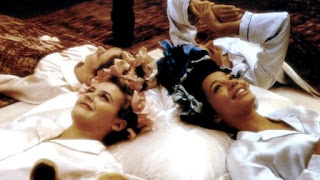

So did you notice the occasional comments about Ethiop's and general blackness? Well if you did then you're probably wondering if Rosaline is Black. While multiple adaptations have portrayed both a lord and a lady, sometimes neither being Rosaline, as Black, and other adaptations as only Rosaline being Black, while still others with no Black characters, the question is still up for debate.

This question originates in tensions relating to the foreign setting, and Biron and the lord's comments regarding Rosaline's coloring. For starters, Navarre is in Spain and the ladies are from France. The original occurrence bringing the two parties together was war and debt (making the seriousness of the lord's broken vow make a little more sense, as well as heightening the likelihood that a character, whether Rosaline or not, would be foreign as well as of a different ethnicity). Apart from that, Biron complains of her black eyes at first. And the King teases Biron saying: "By heaven, they love is black as ebony. . . . / Biron: No face is fair that is not full so black. / King: O paradox! Black is the badge of hell. . . . / Biron: And therefore is she born to make black fair."

Though the lines remain ambiguous since Biron at one point calls Rosaline pale, leaving the audience to wonder if she is pale with black hair and eyebrows and eyes, making their exaggeration one of love's antics, or if she is actually Black. But either way, it gives an opening to introduce diversity into the play and into the most central couple at that. Maybe echoing here are the remnants of Shakespeare's "dark lady."

-Natalie Cherie

Wednesday, August 20, 2014

Powdered Glass and Madness: The Invisible Man by H.G. Wells

Today's the day! This is the first week of my book review/club blog post series. Enjoy. :)

This post may contain SPOILERS! I don't plan on censoring what I write so if you don't like ruined surprises I suggest you read the book before reading this post. Also, if you have any other ideas, concepts, or analysis up for discussion please feel free to comment at the bottom. I'd love to hear everyone's thoughts on the novel.

The Invisible Man was published in 1897 by H.G. Wells. Often considered one of the "fathers of science fiction," H.G. Wells created an unmistakable impression upon science fiction and the conflicts that can arise from discovery. Laying the foundation for imaginative possibility and fantastic situations, Wells also gave us insight into humanity by placing people in situations that provided uncommon strain, leading to enlightening reactions. 


So what is so frightening about the possibility of an invisible man? 

Human definition, control, and accountability. These three concepts are the backbone of The Invisible Man. 

Human Definition

So let's begin with a human definition. Human definition is not justly based on the five senses. We can be blind and still be human or we can be blind and the person we cannot see is still human. Same with smell, taste, touch, and sound. But if this were the dilemma in The Invisible Man it would have been solved easily and there would be no novel. It is obvious that this issue is not whether or not Griffin (the invisible man) exists but rather what he is now defined as. The issue becomes that he has literally changed his make up to render himself invisible. This makes it so that no one can see him, whether their eyes are fully functional or not. He begins with removing the pigment from his blood. Already being an albino, Griffin has less difficulty rendering himself pigment-less. Once he has no pigment he uses the serum he has invented to lower refractive index (the number used to describe the way in which light propagates through an object, level of refraction, reflection, absorption, etc.) and lowers his own refractive index to that of air. Thus, he becomes invisible. 

The question now is: Does a visible human body play a functional role in the definition of a human? Some may say, "Of course not. He's still a human whether anyone can see him or not." This would be supported by his remaining need for food, shelter, sleep, clothing. Others may claim, "He changed the actual chemical reaction of oxygenated hemoglobin (which creates the red pigment of blood). He also had to alter the other respiratory pigments haemocyanin, haemerythrin, and chlorocruorin which, when becoming oxygenated, deal with the colors blue, green, red, and violet. Had he not been albino he would have also had to alter his skin pigmentation. This would have tampered with his melanin which would have resulted in genetic alteration." The pigment-less human being: just an abnormality or something new, something not human? 

Interestingly, had Griffin had the capability to control his invisibility by "turning it on and off" we might have thought of him as a super hero or in his case super villain. But because he could not switch back and forth he became a fearful monstrosity, unable to function in society, and frightening to everyone. Interesting that a visible corporeal frame could make such a difference. 

Control

The next question we are forced to consider in The Invisible Man is "how would I react with the control wielded by the invisible man and my lack of control because of his existence?"

Probably not well.
At first, I was inclined to criticize the resident of Iping, who would sit and gossip and then only scream and run away horrified at the truth that they had complained at not having. But as the character and purposes of Griffin were revealed I realized that he had proved to be the exact man whom no one wanted to be in control. At one point Griffin explains his ideas of a "reign of terror" to Dr. Kemp, saying that it would begin with a few inconsequential deaths to establish his power. At another earlier point in the novel, we realize that Griffin has been robbing people since before he became invisible, a habit that has only worsened with his added advantage and inability to provide his own income. Griffin also has an explosive rage which is probably fueled by his occasional use of strychnine as a freaking sleeping aid! Just for those who don't know, strychnine poisoning is one of the most commonly portrayed cinema and literary poisons because of its being one of the most dramatic and painful toxins available or known. Griffin is also tending towards madness. Whether due to his rage, disregard for human life, or his belief in his own impunity, Griffin has created a monster of himself. He deprives others of their most basic ability towards self-preservation: seeing the enemy. He deprives others of their most basic means of survival: money and means. He deprives others of their most basic right: life. 
Needless to say, I wouldn't react very well to the invisible man's existence either. Killing him becomes an issue of ethics. Did the police force have the right to use brutal force, resulting in Griffin's death? Was it a necessity because of Griffin's unjust power and menacing control? Did they even mean to kill him? It is very likely that Griffin's death was unintentional since they didn't know how to contain him otherwise, and frankly couldn't see where they were hitting or what and how much they were damaging him. But the commentary still stands: human fear is almost always rooted in a certain lack of control.

Accountability

This final concept constitutes less of a question and more of a statement. Most people agree that accountability while often avoided through means of dishonesty, is always deserved since our actions necessitate the corresponding consequences. Yet in The Invisible Man, Griffin seems to believe himself outside of the "common conventions of humanity." In his conversation with Dr. Kemp, it is obvious that Griffin thinks the end justifies the means. He is eerily nonchalant as he explains that he can't be blamed for necessity: robbing his father and his father's consequential suicide, robbing and tying up a man who lived alone and never checking if he was found, killing people to establish his "reign of terror," threatening people because "he chose them" for a specific job. It's pretty unnerving to watch Griffin so easily deprive others of their livelihood, freedom, lives, privacy, safety, etc. while still maintaining that he himself should be left alone. To Dr. Kemp he explains that "I've a particular objection to being caught by my fellow-men." My question is, "And...?" It's simple to say one objects to being caught, heck we all do. But if your actions necessitate the chase, then good luck. 
Dr. Kemp agreed. But he went a step further, not only allowing the hunt to begin by betraying Griffin but by depriving Griffin of his own necessity. He cut off his means of shelter, food, and clothes. He set out police dogs. He alerted the trains, grounding Griffin's ability to travel. He even suggested lining the roads with powdered glass. When Col. Adye starts at this idea expressing its unsportsmanlike flavor, Dr. Kemp simply replies, "The man's become inhuman, I tell you. . . . He has cut himself off from his own kind. His blood be upon his own head." Essentially forcing Griffin to receive the consequences that his actions have required.

The Invisible Man

In the end, Griffin is killed by a mob who is trying to stop him from murdering Dr. Kemp. It's interesting because as he dies his body slowly becomes visible again, making the cruelty he suffered just as visible as the cruelty he dealt out. 

Quotes from The Invisible Man
*all sections of quotes in bold was a change I introduced, not included in the original text.

"The more I thought it over, Kemp, the more I realised what a helpless absurdity an Invisible Man was—in a cold and dirty climate and a crowded civilised city. Before I made this mad experiment I had dreamt of a thousand advantages. That afternoon it seemed all disappointment. I went over the heads of the things a man reckons desirable. No doubt invisibility made it possible to get them, but it made it impossible to enjoy them when they are got. Ambition—what is the good of pride of place when you cannot appear there? What is the good of the love of woman when her name must needs be Delilah? I have no taste for politics, for the blackguardisms of fame, for philanthropy, for sport. What was I to do? And for this, I had become a wrapped-up mystery, a swathed and bandaged caricature of a man!"

"It was worse than anything. Mrs. Hall, standing open-mouthed and horror-struck, shrieked at what she saw, and made for the door of the house. Everyone began to move. They were prepared for scars, disfigurements, tangible horrors, but nothing! The bandages and false hair flew across the passage into the bar, making a hobbledehoy jump to avoid them. Everyone tumbled on everyone else down the steps. For the man who stood there shouting some incoherent explanation, was a solid gesticulating figure up to the coat-collar of him, and then—nothingness, no visible thing at all!"

"He has cut himself off from his own kind. His blood be upon his own head."

"A feeling of extraordinary elation took the place of my anger as I sat outside the window and watched these four people...trying to understand the riddle of my behavior....I was invisible, and I was only just beginning to realize the extraordinary advantage my invisibility gave me. My head was already teeming with plans of all the wild and wonderful things I had now impunity to do." 

“And there it was, on a shabby bed in a tawdry, ill-lighted bedroom, surrounded by a crowd of ignorant and excited people, broken and wounded, betrayed and unpitied, that Griffin, the first of all men to make himself invisible, Griffin, the most gifted physicist the world has ever seen, ended in infinite disaster his strange and terrible career.” 

“But-! I say! The common conventions of humanity-Are all very well for common people.” 


-Natalie Cherie

Tuesday, August 12, 2014

A Summer for Reading

This has been a summer of reading. I work at Mail Services on Brigham Young University campus. And I often feel like this.
Okay, so when a person (or rather an English Major) sits at their job, often having 4 or 5 hours of downtime added up by the end of the day, what are they supposed to do? The answer: ding ding ding! read. And that's what I've been doing. So now that I've read 25 works this summer, ranging from plays, novels, and series I thought I'd share my thoughts on them with you. So whether you'd like to treat this experiment as a book review hub or rather a book club of sorts where you can read along with what I've been reading, feel free to join in. I'll be posting a review of a new book once a week. I may occasionally interrupt with an essay to read and then a writing exercise for writing enthusiasts but in general, you can expect a book a week. It will go roughly in this order since the top of the list holds my most recent reads.

The Invisible Man by H.G. Wells
Love's Labours Lost by William Shakespeare
The Awakening by Kate Chopin
Macbeth by William Shakespeare
The Giver by Louis Lowry
The Taming of the Shrew by William Shakespeare
Mansfield Park by Jane Austen
Mockingjay by Suzanne Collins
Catching Fire by Suzanne Collins
Allegiant by Veronica Roth
Insurgent by Veronica Roth
Divergent by Veronica Roth
Much Ado About Nothing by William Shakespeare
The Old Man and the Sea by Ernest Hemingway
The Sun Also Rises by Ernest Hemingway
All Quiet on the Western Front by Erich Maria Remarque
Wyrd Sisters by Terry Pratchett
I Know Why the Caged Bird Sings by Maya Angelou
The High King (Chronicles of Prydain #5) by Lloyd Alexander
As I Lay Dying by William Faulkner
Taran Wanderer (Chronicles of Prydain #4) by Lloyd Alexander
The Castle of Llyr (Chronicles of Prydain #3) by Lloyd Alexander
A Tree Grows in Brooklyn by Betty Smith
The Black Cauldron (Chronicles of Prydain #2) by Lloyd Alexander
The Book of Three (Chronicles of Prydain #1) by Lloyd Alexander

-Natalie Cherie