Thursday, May 16, 2013

Stumbling with Sheep (and a really gross, true story)

Sitting at the farmhouse which supposedly
inspired the imagination of Emily Bronte
creating Wuthering Heights
So today I'm in York and I finally have WiFi again! We spent most of the day exploring Fountain Abbey which was lovely and very extensive. We were there for four hours and still could have seen more. While I was without WiFi I was exploring quite a few cities such as Haworth, Earby, and Malham. In Haworth, we saw the Bronte Parsonage which was as dreary as I expected it to be. The Brontes were brilliant and much of their works reflect the bleakness in which they lived. Their lives were coated with instances of death and harsh reality as can be seen in the novels of Jane Eyre and Wuthering Heights, both believed to be either somewhat autobiographical or a reflection of psychological state. One detail I'll mention about their home is one that I found to be particularly fascinating and (heads up) disgusting. The mortality rate in their little town of Haworth was devastatingly high. Many children died before the age of six and many adults before the age of twenty-five. When attempting to determine why so many were dying they found many problems with sanitation, but it wasn't until years later that they found what I believe to be the most disturbing discovery. Adjacent to the Bronte Parsonage is a small and overloaded graveyard (my picture doesn't do it justice but there is literally no room to walk amongst the graves as the hundreds of stones overlap each other). This graveyard now serves as the final resting place for some 42,000 bodies.
The bodies in this grave were disposed of by piling
A small section of the graveyard which sits next to the
Bronte Parsonage in the background (through the trees)
them on top of one another in a pit then being covered by a flat stone. The names of the dead were carved into this stone until it was full, then being turned over to carve more names. The problem with this besides the obvious is that the flat stone prohibits the access of air to the soil. Therefore, the bodies couldn't decompose either partially mummifying and rupturing from liquid and gas pressure. This, while already disturbing becomes revolting when we realize that the city's water supply ran directly under the graveyard and retained significant amounts of contaminated seepage from this process. Now that we are all thoroughly disgusted I think I will move on.

A view of the never-ending Moors
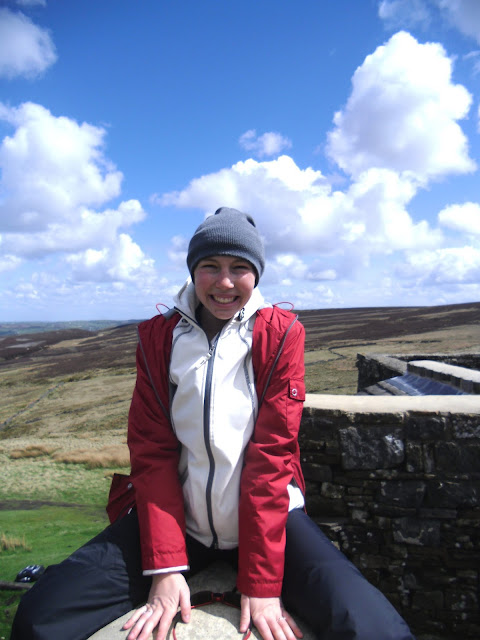
Anyway, so the Moors are as dangerous, never-ending, and wild as everyone has always said. Even now bodies are occasionally found of those un-cautious hikers who have paid the price. That was fun to hear literally right before we began our own excursion. But as you can tell from my current post all is well. So the Moors are composed of miles and miles of heather and heath rolled on the sky a dim, grey, stormy color and the wind blowing so as to wipe us from the face of the earth. It would hail on a whim and we were constantly avoiding marshy mounds and sunken ground. Every so often a small hare that couldn't survive the elements was lying on the side of the path and at every moment I felt the thudding of my heartbeat, the heavy breathing, and searing pain in my knee corresponding with the rushing warning present in the wind which swarmed around us. Unfortunately, the hike was some 18 miles long and so I had to cut out after a couple of miles due to pain but I was able to spend the afternoon with Pat's (my director's) little girls Dani (age 7) and Sarah (age 9). We had a tea party and talked about our adventures that day. It was my first tea party in England. We all enjoyed it immensely and Dani even spoke with a British accent.
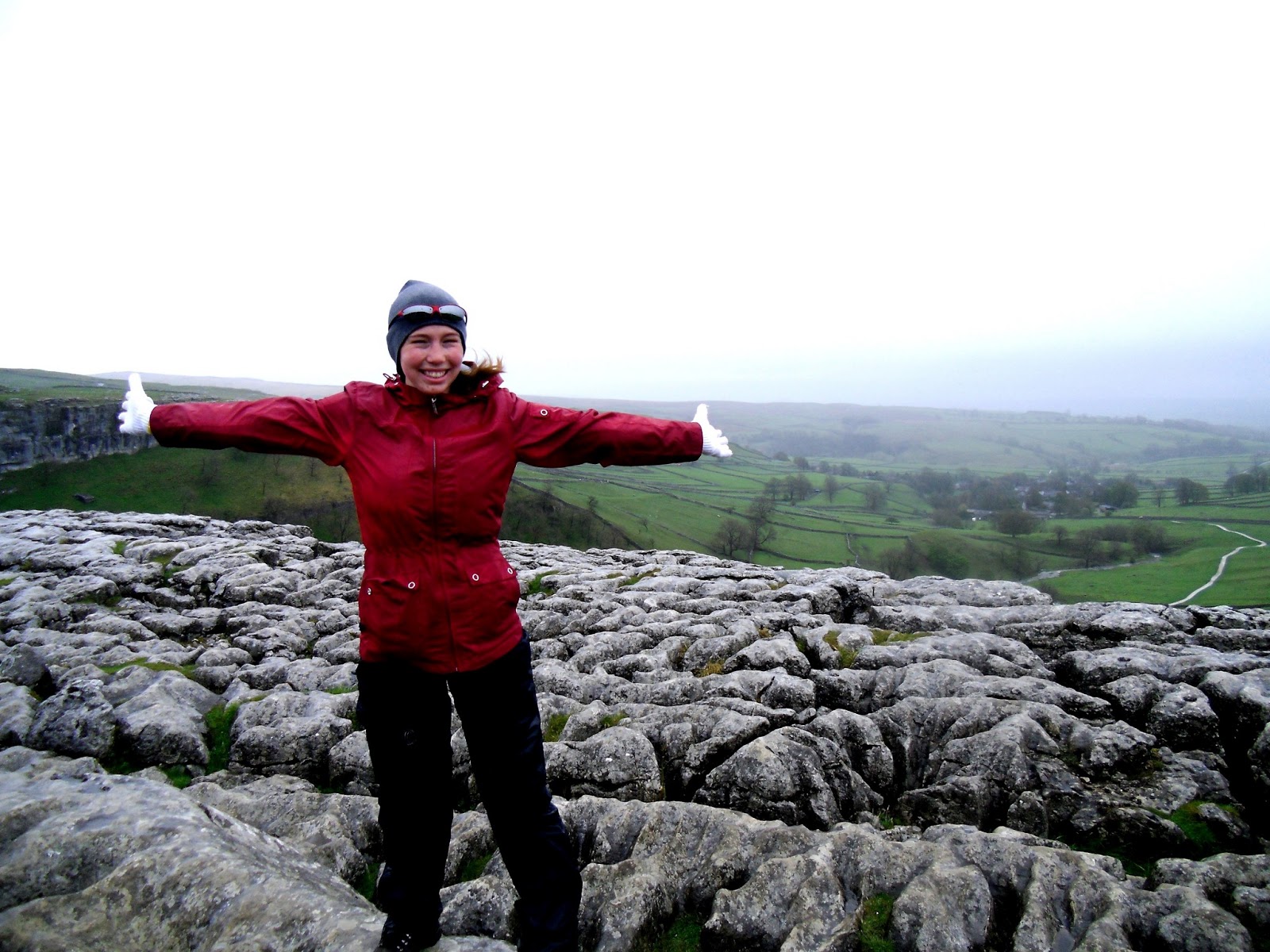
On top of Malham's Cover standing where Hermione and Harry
stood amongst the Clints and Grikes
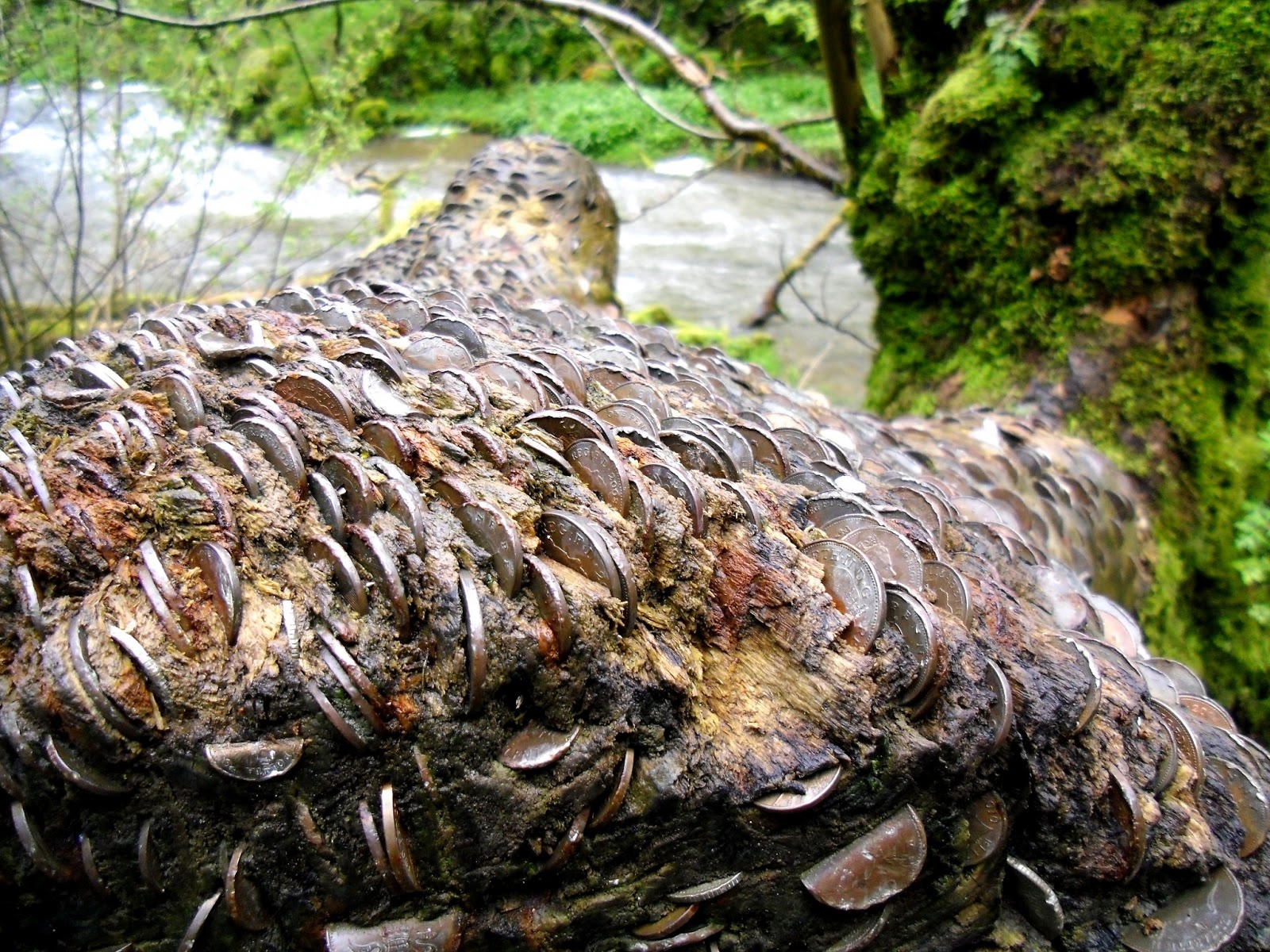
Before leaving the Malham (the town we hiked to via the Moors) we stopped by Janet's Foss and Malham's Cove. The cove is actually the site of one of the Harry Potter Seven scenes so it was really cool to be up amongst the fissures and cracks we recognized. The cove is actually limestone so the stone is called a Clint and the "spaces" the Grike. Once again it was raining but that added to the atmosphere. After we stopped by the waterfall (Foss is a Nordic word for Waterfall) believed to be home to the fairies of Queen Janet where many make wishes by leaving coins in the trees. It was almost disturbing to see the money which seemed to almost grow from the bark as a virus or unnatural plague of man. I can't quite describe it but it left me feeling eerie. So now for the next essay in what will become my portfolio for this trip. It is a descriptive essay based on an object. I picked sheep and for any who want some funny light reading, it resembles Beerbaums essay, "Going for a Walk." Enjoy.
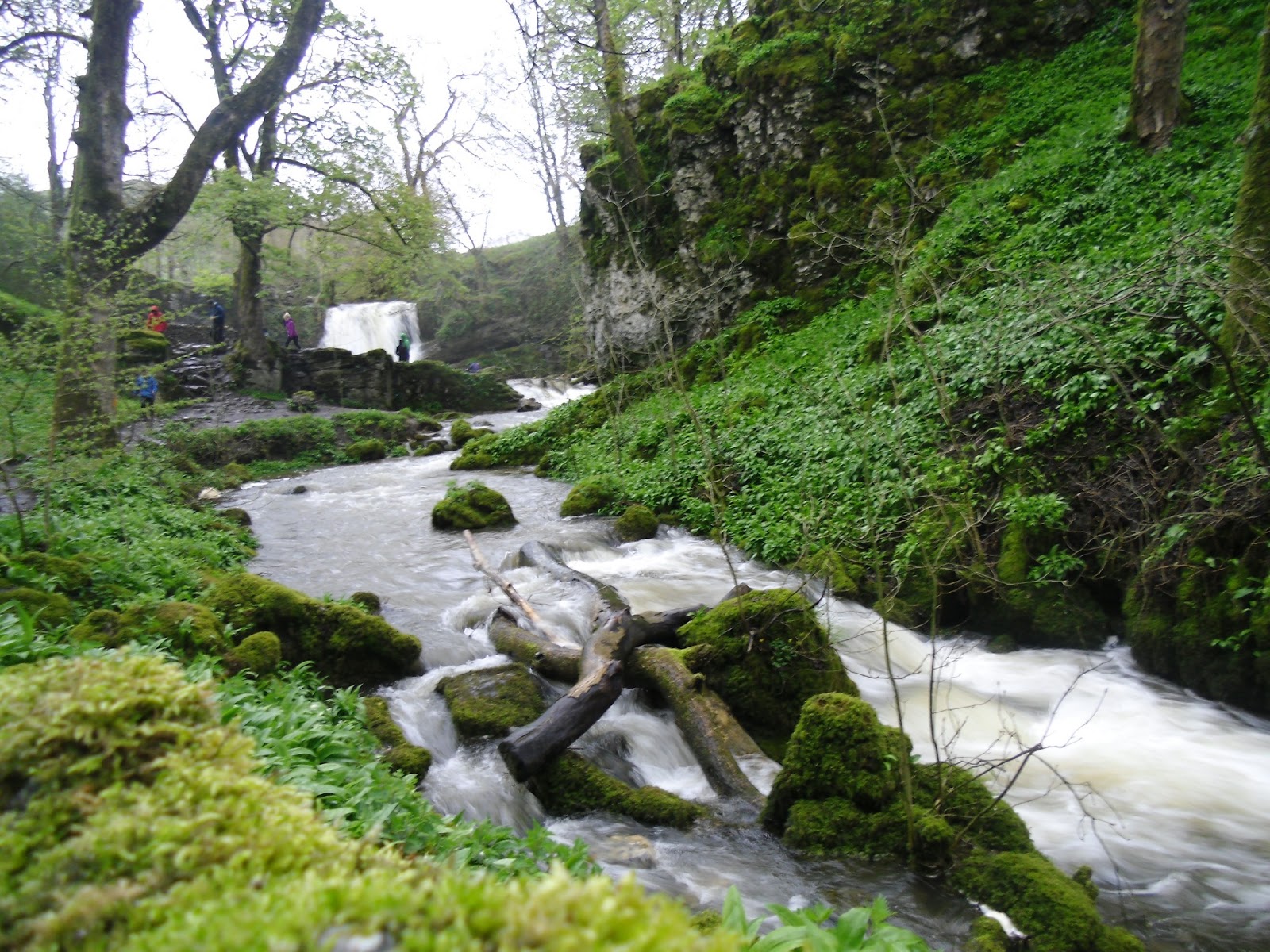
Janet's Foss
The Money Tree
Stumbling with Sheep

I had never seen a sheep before coming to England. But now I have seen too many.
As you can tell these are sheep ;)
Whilst walking the public footpaths one cannot help but wonder how one of the most iconically lovable babies in the animal kingdom, the lamb, can grow into one of the least attractive animals in, no longer the animal kingdom, but the meat and clothes industries as mutton and wool. Before they are thus used each sheep looks much the same, their woolen coats whispy but shaggy, only those which are half-shaven standing out amongst the rest. These half-shaven sheep are of the group which seems to have contracted a strange form of woolen leprosy. The live illusion of deterioration is fixed by the fragmented patches of wrinkled pink skin and limp strips of dirty wool, twisting in the breeze as each sheep hobbles to its new grazing mound. As they hobble along one cannot help but notice the splotches of sprayed green, pink, or red on its coat which marks out its value and inevitable home on a plate of Haggis, Neeps, and Tatties. And, if one continually walks the countryside and its public footpaths this, besides the innumerable poop droppings, is all one will see in England's never-ending mass of sheep, pastures, and hedgerows.

Upon coming to England I was instructed to find inspiration in the landscape. But, as I quickly grew tired of sheep I also found the landscape to grow lackluster in inspiration. I suppose one could argue that there is much more to inspire than just sheep. And I suppose them to be right. But the point is not how much there is to inspire but whether or not it does. And frankly, it does not. For though the landscape is lovely, to be sure, it varies as much as one sheep to another.
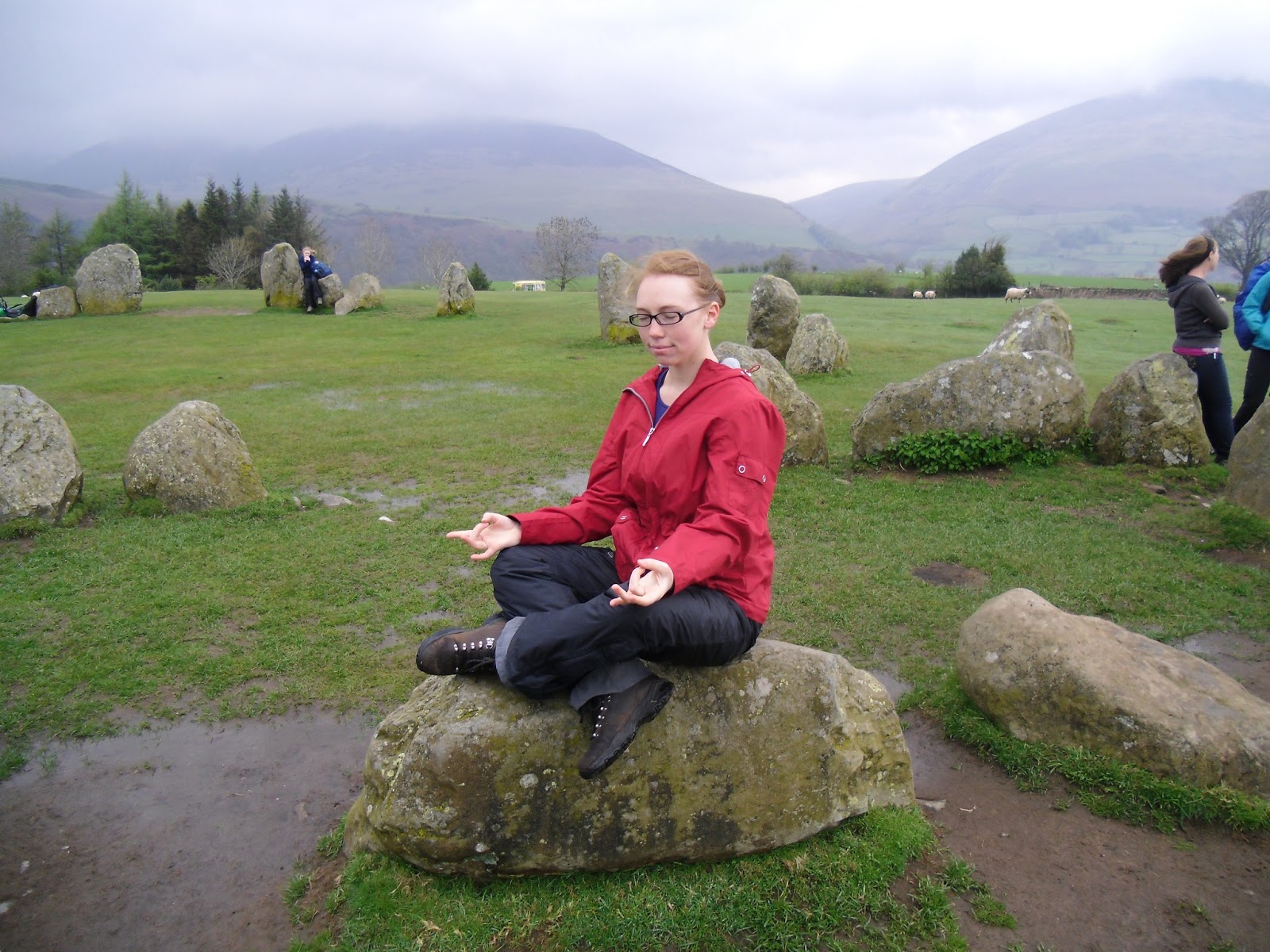
Meditating at the stone circle in Keswick called Castlerigg
Though this assertion is quite contrary to the "Wordsworthian" ideal, I find that instead of waxing poetic or profound in a "spontaneous overflow of powerful emotion" I rather become as methodically concerned with where I step as a sheep does with nipping the next tuft of grass. With their black and white, oblong faces turned downward a sheep may spend its whole day in no other pursuit than to feed and bleat at those of us which come to near. And though loathe to compare myself to a sheep, I too find that nature serves to numb the creative brain as one's eyes become the primary instrument, continually peering and hoping to avoid the droppings, puddles, marshy patches, and muddy holes that plague the common English footpath. In this way nature, indeed, is entirely unsuitable in providing inspiration.

In one fatal moment, my argument could be entirely under-minded by the voice that says, with what I'm sure is great validity, "I have been inspired by nature, and in fact, it suits very well." Therefore, in an effort to avoid such a feeble folly in my own writing I will assert that Truth never was my opinions but rather the simple observations of my own meandering mind. And in such observations, I have discovered that nature is entirely unsuitable in providing inspiration. Nature may instead serve as a calm and sublime numbing for the pressing thoughts that have not yet received enough reflection, which I find requisite, to adopt words necessary for the expression of profound application. Whereas inspiration is best catered in the places that let thoughts race while the body is still, the nurturing of these thoughts is best attended to while the mind is quiet and the body invigorated.
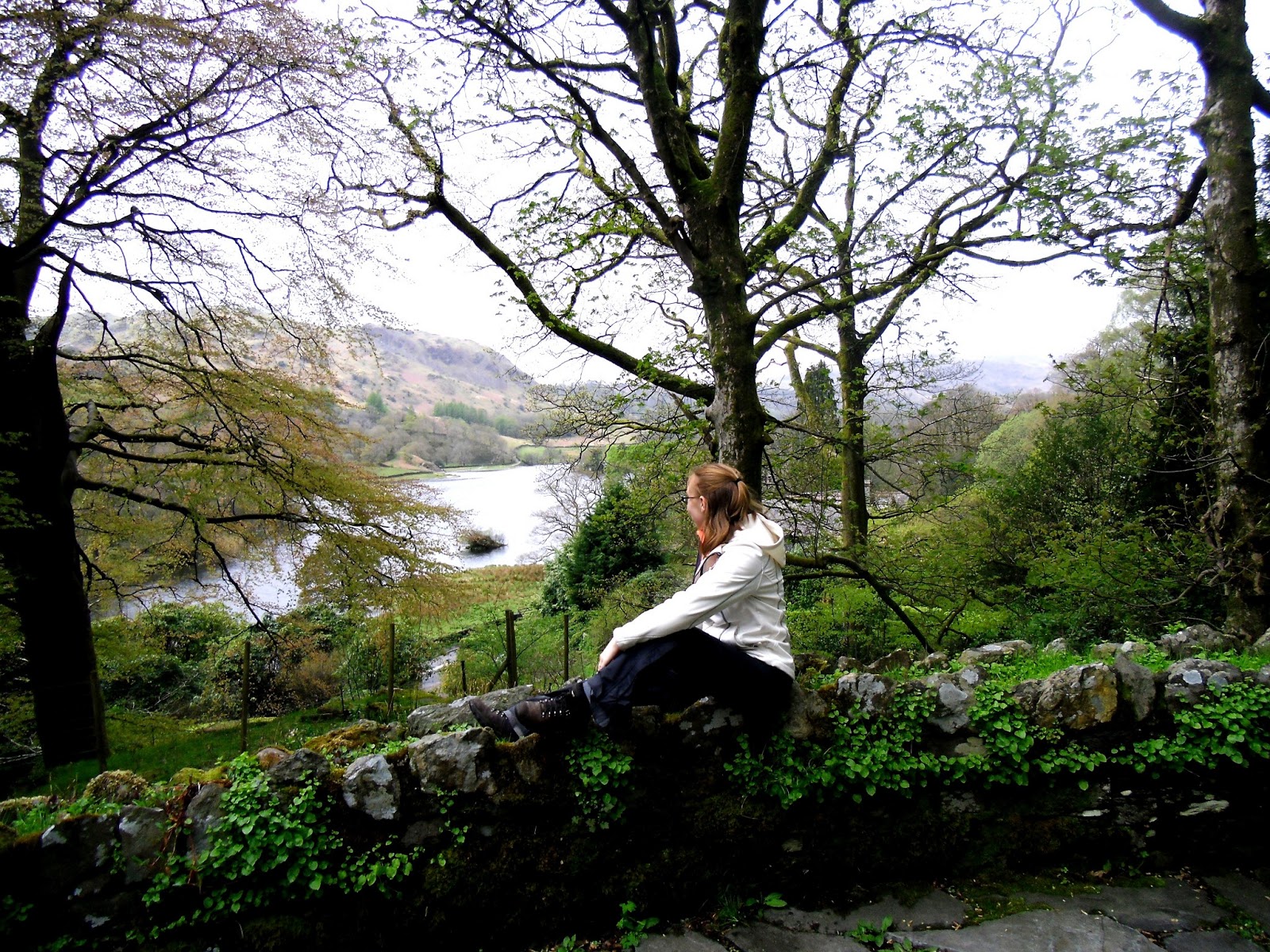
Taking a moment to reflect at Wordsworth's home
Rydal Mount in his numerous gardens
Places of inspiration found on park benches, outdoor cafes, or one's fireplace allow the brain full capacity and free will. In such moments when one's energy is entirely dedicated to the mind, it is little wonder that thoughts begin to wander, musings meander, and ideas stumbled upon. Places of reflection such as English footpaths or pastures of grazing sheep give repose, allowing the mind time to move about in the world. And while thoughts lie dormant, connections between the outside world and our internal realities may be re-formed and re-discovered, this being rendered possible no matter how invariable or methodical the landscape may be.

When searching for inspiration I have found that nature and sheep, whether sublime or ugly, do very little for creativity. For no matter how one looks at their surroundings inspiration must stem from the internal workings of a comfortable mind. Nature may grant experience for some future musing or provide the mind-numbing stillness that incubates ideas, but it simply cannot provide original thought when its only tools are shaggy sheep and mossy stone walls.

It is true that this essay was derived from my disdain for sheep, which some may title Inspiration, but I would assert that it is rather a reflection, because though both are important they are not one in the same. And sheep do very little to inspire.


-Natalie Cherie

Thursday, May 9, 2013

The Contrary Conversation

Edinburgh, Scotland skyline from Waverley Bridge


Hello everyone! So I'm currently in Grasmere, England, at the home of Wordsworth and DeQuincy. There are so many things I could write about but instead, I think I'll start with my essays and musings. So just to fill you all in, I'm spending the Spring traveling and hiking across England, Scotland, and Wales in an effort to more fully explore and learn about the poets and authors who've been influenced by the landscape, as well as learn the art of travel writing and essays. We spent our first week in Scotland (the first half in Edinburgh and the second half off the shores of Loch Lomond). From there we hiked Scafell Pike (the highest peak in England) and then stopped in Keswick with Castlerigg and are now in Grasmere. It has been fun to see new places and learn new things. It's very green and wet and the people have been kind. Unfortunately, I've had some problems with my knees and Achilles tendon but c'est la vie, Steve (a fellow Scafell Pike hiker) told me it will only get worse with age so take advantage of what I have now . . . I think he's right. :) Well, in hopes that I can show you what I don't have time to say, I have just a few pictures with many more to come.

Paige and I in the Edinburgh Larder for a breakfast of Egg Toast and Bacon with Scones and Mum's Jam
Anyway, this first essay was a challenge to simply be contrary. Essays should be an effort to engage in conversation with oneself and to explore the capacities of thought. So in that light, this essay is really just a contrary conversation. In this one we took an idea that was typically held as positive or negative and represent it in the opposite light. I chose the relatively positive view society holds of open-mindedness. Enjoy.

Standing on top of Arthur's Seat
The Other Side of Open-Mindedness

I remember it was in a conversation, where I first encountered the perspective that being open-minded could be detrimental. 
Taking the train to St. Andrews


The state of mind, as I recall, was likened to a drinking glass. I was told that each part of the glass symbolized a part of our mind. The sides of the glass represented the lens by which “we” (the glass) perceived. The sides were very rarely removed and only occasionally altered. The bottom of the glass was also considered immovable, serving as the glass’ foundation, its reference point and compass by which the results of its perceptions were determined.

On the Shoreline of Knowledge
Hiking to the Rock and Spindle in St. Andrews, Scotland
With Christ Arthur (a fantastic essayist)

By this model, a close-minded person was one who had a full glass no longer containing space to integrate new ideas. An open-minded person was one with an empty glass, still allowing space for new ways of thought to fill their “mind.” Of course there were varying levels of fullness, but overall the concept was quite simple, until someone, maybe society, a group, or perhaps an intellectual thought to remove the base. Thus, our current perception of being open-minded, what many feel is the “ideal” state of mind, became skewed from its original form.


This shift in thought may seem small but it has created monumental changes in how people communicate with each other. Consistent accusations and misunderstandings occur, especially within social issues based on the simple difference in definition. One is not open-minded enough, the other has no principles. One cannot understand why being willing to examine new ideas is not enough, while the other is frustrated by the occasional unwillingness to integrate most and all new ideas. This conflict, over simple denotation, has led me to wonder if the new and “baseless” approach to open-mindedness is not, after all, detrimental.

The top of Arthur's Seat in Edinburgh

If we were to consider what many people might use as their own base then we’d most likely find the words religious belief, political opinion, welfare of loved ones, ethical code, etc. Are these things that we can honestly fault people for having and safe guarding? Having a core to which we hold is much like having an oar or tiller with which to steer a ship. Without a tiller or a drinking glass bottom a ship would go nowhere and a glass could not hold water. Though the pretense of never having to leave the seas of knowledge or being constantly exposed to the flow of intelligence is comforting, it ceases to be so when our state of mind stops progressing. We may see the waves around us and not be a part of the current, we may have water flowing through us and never retain any. By denying the mind a purpose, it does not matter the situation or pathway an attempt at progression and intelligent integration is futile. Thus, a foundation-less approach to open-mindedness, however good one’s intentions, is sure to lead to the progression of many causes, little enemies, and a thorough neglect of one’s own welfare. With this in mind it seems as though, whether purposeful or not, the new requirements of open-mindedness are rather manipulative. By expecting a person to rid themselves of their foundation and beliefs so that anything becomes acceptable and one cannot disagree those who hold such an expectation seek to make a number on a petition of a mind, an unthinking ally at a rally, or simply render them incapable of becoming a force of opposition.


For some, this open-minded-mode may be just the ticket to avoid such unpleasantries as disagreement, offense, or worst of all appearing close-minded. Being truly open-minded is much more difficult than this, for, it requires effort to maintain one’s base while exerting a willingness to seek understanding from other points of view. Those who attempt such an approach risk offending many, but will undoubtedly gain further understanding as to other perspectives and how different ways of thinking shape the minds of the masses as well as decide how those ways of thinking will shape their own mind. Maintaining this type of grounded open-mindedness creates a proactive force for progression, not to be used for every purpose but rather to define and pursue their own purpose.

The view from the peak of England's Scafell Pike

Perhaps this individualized purpose has created its own path to atrophy. Much like the frustration of accomplishing nothing, attempting to accomplish anything while each foundation caters to a different purpose can be as equally hindering. It may be that amidst this frustration of differing agendas the term “acceptance” was applied as a cure-all, a mediator between the differences that composed individual bases. But, it is in this misapplied word that the first crack in the glass was triggered. Thus, our attention has been forced to fixing the cracking glass instead of the examining the different paths one may take in the process of filling or emptying it.

Loch Lomond

Our discourse would be ideal if we could use such essays to address the question as to which state of mind, open or close-mindedness, is better. But unfortunately we cannot. Because we have, for so long, attempted to solve each problem by turning to the catch phrase of acceptance we have deteriorated the very structure of our means of perception and relative integration. Our very words have become skewed to mean different things, leaving comprehension impossible unless one is lucky enough to stumble across someone who understands the connotation as we do. Open-mindedness is not the only one, and for each word on society’s list of variable application we must re-establish the meaning so as to rescue its contextual application. Such it is with the “open-minded” who can no longer claim such a widely differentiated characteristic as their own.


The framework of our minds may remain as structured or unfettered as one chooses. Yet, a framework must remain. It is true, an empty glass holds the most potential of any model we’ve examined, but most importantly is not that it’s necessarily empty, but rather that it can hold water. Many a great cause has been influenced by those willing to understand and fit it new ideas, these we may call open-minded. Many masses of people have been herded and used in their inability to sort through good and bad ideas and their respective consequences. These we may call open-minded. The open-minded have been known for both intellect and blind hope, progress and wishful speeches. Both groups we may call open-minded but they are fundamentally different. We must notice the difference and realize that it begins in the mind, and the mind begins with sides and a base.
Molly and me on Scafell Pike


Writing with stones on Arthur's Seat
-Natalie Cherie

Saturday, April 20, 2013

The day I was going to get married...


So this is Spencer and I at our best . . . yes he is singing. :) Now, I thought that I would take a step back and tell about this last weekend. April 13th to be exact, the day Spencer and I were originally going to get married. So first off every time I mention this people are really hesitant to say anything. I assume they're wondering if I'm okay, bitter, sad, etc. So for the record I'm fine, great even. It was just a little weird, that's all. So Spencer and I decided to go out for dinner in celebration of our almost union (which now is going to be July 6th, in case you were wondering). First of all, we went to Cranky Chuckie's American Bistro or some strange name like that and it was fantastic. It was in the upstairs of an older building in a cute little nook a block from BYU campus. The menu was small, maybe six main courses in all, three appetizers and three desserts. But for me that was perfect: not too many choices not too few. So Spencer and I both ended up getting the bacon-wrapped meatloaf with mashed potatoes and Brussels sprouts and it was delicious! I can simply not say enough about this meal so I will not even try. Just for your information, though the dish convinced me that barbecue sauce is not inherently the most disgusting thing ever, so that was a huge step for me. Anyway it was delicious and I had a pizookie for the first time and then we found it necessary to eat more so we stopped by Spoon It Up for some frozen yogurt. So this part was really fun because Spencer was so excited to get exactly the right flavor combinations between our bowl of fruit and our other bowl of chocolate. With great concentration and concern I layered the mint and dutch chocolate, while he created a collage of mango sorbet, strawberry, and french vanilla. So for the toppings we basically went all out, carefully leaving out the coconut for Spencer's benefit (we trade off since it's my favorite). We also discovered these really weird gusher-like balls of fruit-flavored excitement which Spencer thought were fantastic. p.s. It's adorable when he gets excited about little things like fruit-flavored-gusher-balls-of-explosive-magic so I just thought I'd mention it. Anyway, the rest of the evening consisted of Downton Abbey, talking, and cuddling. A perfect evening . . .
. . . And then I remembered that we were celebrating our almost marriage. Weird! I mean in all reality, I'm leaving in less than a week for a study abroad. We're in the midst of finals. We'd have had no place to live. Etc, etc. I mean it's a very good thing that we moved the date to July 6th (also because we will have fireworks every year in honor of our anniversary, as well as our country...and because Claire can come! Unfortunately, my best friend Sarah will be in England but that's okay, England's pretty cool I guess). Well, all in all, I have no feasible way to describe the day one should have been getting married. Our celebration was fun but the other side of the story was not. Because for some reason, after such a wonderful evening, I kind of had a mini breakdown. Maybe it was that I was getting sick, maybe I was tired and stressed with upcoming finals, maybe I'll just shamelessly blame birth control, or maybe the Downton Abbey episode got under my skin. But either way after a little coaxing and comfort from Spencer it came out that I needed to know if Spencer still wanted to marry me. Dumb, but legitimate, at least in my head. And I suppose that looking back at that evening now I see what makes every good marriage. The ups and downs, the fun times and the sad times, the comfort, the time invested, and everything else between.
You see, technically our excursion was the night before our "almost marriage" so I guess it could have resembled the "almost before marriage jitters" but the next day was overly normal, busy, overcast, boring, basically normal? Really I can't describe it. But what I can say is that I am very excited to get
married, and Spencer is really great. The next couple months of my life are slated with amazing opportunities from England, Scotland, and Wales, to marrying and starting a new life with Spencer. I kind of want to make our almost wedding day a secondary anniversary (mostly so we can celebrate twice) but really what I remembered from the day I was going to get married was all the reasons I love Spencer. From exploring new places, eating new foods, systematically creating pleasureful bowls of goodness with green spoons, Spencer comforting me through a random crisis, or just spending time together reading, talking, cuddling, and laughing I can't for the day we actually get married. So in honor of our almost wedding day here is the story, and here are some of our engagement photos. Now I'm off to my French final.
https://www.dropbox.com/sh/vh1p4ahyxy6k0gp/U3euIb8CCZ

-Natalie Cherie

Thursday, April 11, 2013

When Now Unstiches Then


Two weeks ago I decided I was going to become an essayist. Why? Because I started reading The Rings of Saturn by W.G. Sebald. To be perfectly honest, this novel (or series of 10 essays) are rather confusing, initially, I found them meaningless, and overall a difficult and uninspiring read. And then I took a second look. Within the pages of an unsettled and shifting conscious I found the remnants and threads of a truly beautiful experience. But perhaps just as important I found myself in the words and mind of a human being I didn't know. Someone who expressed the reason I write.


“But the fact is that writing is the only way in which I am able to cope with the memories which overwhelm me so frequently and so unexpectedly. If they remained locked away, they would become heavier and heavier as time went on, so that in the end I would succumb under their mounting weight. Memories lie slumbering within us for months and years, quietly proliferating, until they are woken by some trifle and in some strange way blind us to life. How often this has caused me to feel that my memories, and the labours expended in writing them down are all part of the same humiliating and, at bottom, contemptible business! And yet, what would we be without memories? We would not be capable of ordering even the simplest thoughts, the most sensitive heart would lose the ability to show affection, our existence would be a mere never-ending chain of meaningless moments, and there would not be the faintest trace of a past.” 
-W.G. Sebald

Later I began to read some essays from On the Shoreline of Knowledge by Chris Arthur. Once again I found a confusing, seemingly meaningless representation of the wanderings of a human mind. But then I was instructed to find a poem in the words. Kind of weird, but this is what I found.

When Now Unstiches Then and is in Turn Undone

When Now un-stitches Then,
This harpoon from the past-
Sharp, pointed, barbed-
Carries with it a reminder that everything we do
Is transient, mutable; that memory's sarcophagi
Are buried in the sands of change;
That the moments which we colonize now,
Our perceptions, our fragile present,
Are already marked with obliteration.

[But,] I know- with a certainty
That outweighs the most cherished particularities of memory-
That I should welcome anything that helps
Attune the ear to time's complex harmonies.
Google may have made once stable images
Come crashing down,
But in the sound of their falling, I can hear
More acutely than in any monotone of static preservation
The Elusive voices of the moments we inhabit.

And that's what it's all about. I've often sat down an wondered where I would find my own meaningful existence. Perhaps in leaving behind a legacy, but would anyone read it. Besides what are words if not read, or understood. Words for the sake of words like Art for the sake of art? No one liked that movement anyway. Okay, it's a gross generalization but what are ink stains and pen scratches when the mocking corrosion of time will all too soon wipe it away? Perhaps this is nothing but the existential crisis of a writer. You see in less than two weeks I'm headed to England, Scotland, and Wales to backpack 200 miles across the countryside.  I'm traveling across an ocean to feel the presence of past lives and the hear past voices. But after the cathedrals crumble, the gardens hedge and hide their secrets and thoughts, and the shores erode their pathways will the word endure. Will a garden and misty morning inspire the words of William Wordsworth when all is gone:

THERE was a time when meadow, grove, and stream,
    The earth, and every common sight,
            To me did seem
    Apparell'd in celestial light,
The glory and the freshness of a dream.         5
It is not now as it hath been of yore;—
        Turn wheresoe'er I may,
            By night or day,
The things which I have seen I now can see no more.
Or will that too fade?

So back to the original question: Why become an essayist when continually faced with such a crisis? Because where Wordsworth is the truth so also are the words of Ulysses by Lord Alfred Tennyson saying, 
Tho' much is taken, much abides; and tho'
We are not now that strength which in old days
Moved earth and heaven, that which we are, we are;
One equal temper of heroic hearts,
Made weak by time and fate, but strong in will
To strive, to seek, to find, and not to yield.

So when I also, like John Keats, have "fears that I may cease to be, before my pen has gleaned my teeming brain," I simply remember that this is my meaningful existence. To write down the story that I have to share, regardless of who opens its pages. And "through living roots [that] awaken in my head, [though] I've no spade to follow men like them. Between my finger and my thumb, the squat pen rests. I'll dig with it." -Seamus Heaney

The other day as I was walking, surrounded by busy students, I myself found a rushing figure in my own person. I was heading to work. And then it stopped. Or began. A gust of wind, before pleasant, had swept away dozens of loose leaf papers from the hands of a stunned young woman. Before the blinking moment, they were slipping across the concrete like lifeless butterflies caught on a harsh breeze. A moment passed and suddenly twenty bodies, before moving in a chaotic, self-absorbed direction, all turned to chase the sheets that held meaningless words. Yet, somehow precious. I myself began to chase down papers succeeding in trapping only two sheets. But, somehow on her face, I saw the meaning of meaningless words. Somehow in our task, I had found my answer. Though now unstitches then and is in turn undone, perhaps I can somehow make something out of nothing . . . something worth chasing after.

-Natalie Cherie

Monday, February 11, 2013

Without a Name (Another Short Story)

As the sun set they first awoke. Looking around, the two girls began to realize there was no way out. What had happened?

Flashback 20 hours ago. Sitting inside a big house (at least the biggest they'd ever been in) they'd just been taken from their hiding place.

Flashback a week. One little girl had just been spoken for by a 52-year-old man. Not as bad as it could have been economically speaking; he had paid very well. This little Indian girl was only nine.

Flashback three days. Terrified the nine-year-old and her twelve-year-old sister decided to run away. Not wanting to leave the family destitute they took nothing. And in order to stay hidden from the imminent search parties, they only walked and wandered at night. But with no destination or food, they couldn't be expected to make it far. And they didn't. A day and a half later the twelve-year-old crawls down from a tree, their secret sleeping place, and begins to dig through the nearest garbage bin for food. Luckily, or perhaps unluckily, she found some old . . . well, it was something edible and takes her prize back up the tree to her nine-year-old fugitive. But soon the stomach cramps start. Next rolls in overwhelming nausea and soon neither have enough strength to remain in the tree. Slowly they crawl, almost falling, into a nearby bush, but they've been noticed. The man had sent out a search party to collect his prize, after all, he had already paid, and the wedding was in two days. Unfortunately, they were sicker than he'd hoped but on the side of fortune, he had acquired two for the price of one.

Flash forward. Just opening her eyes, the nine-year-old felt exhausted and disoriented. On first seeing her sister she feels like all must have been a dream. She's not been sold into an arranged marriage fetching a high price for her . . . virginity? "Is that what they call it again?" But then she sees the man's silhouette. Her heart sinks but not much before it's traded for panic. Soon strange smelling women scoop her and her still unconscious sister off of the ground. They replace her tattered shawls with colorful veils, slippers, and a Kurti. They paint her in the foul-smelling mud until she's nothing but a mesh of alluring designs. But the worst part was when the hot needles and chains began to pierce her nose and ears. By this time her sister had awoken but they had quickly taken her away, so the nine-year-old was left alone, simply waiting for the night to arrive. Surrounded by brass statues and carpets she suddenly felt very alone. But she had no tears left, so instead, she begins to speak, what we would call praying. She'd heard of a God once and thought maybe he or she (she didn't really know which) would listen. Maybe he would even know her name . . . nobody else seemed to or didn't care to use it. But maybe he or she would. She sat very still and looked up at the ceiling, trying to see up to where God was. Playing with her hands she didn't know what to say, so in a little voice she said the only thing she could think of, "Please, God . . . sir, just don't let it hurt."

-Natalie Cherie

Thursday, February 7, 2013

Looking in a Mirror


Today I went shopping for a wedding dress . . . okay, that's a lie. I started this post a couple weeks ago so as of now I went shopping a while ago. Now that that's all cleared up, back to my story.

So imagine that you're with me we're walking into a store. You're being followed by your roommate and two friends who are immensely and overwhelmingly more excited than you are, and to top it all off you feel almost sick and quite ignorant as a cheery young woman singles you out with a "Who's getting married?" (high-pitched voice) and a "What type of dress are you looking for?" In short: I almost ran away. Good thing I was surrounded by overly-enthusiastic women.

Next, I dumbly point at dresses that "have potential" and am led to a dressing room. Then my assistant lady/girl (who was super nice by the way) starts asking about my fiance and I suddenly feel right at home. So, let's be real, the next hour was actually rather enjoyable. I'll totally admit it. The dresses were lovely, I felt great cause they all fit well, and my moral support and three-person strong cheering section were doing a capital job. But the moment I'll remember most vividly was the moment I first saw myself in a wedding dress.

I walk out of the dressing room, the girls all gasp, I blush, yadda yadda, and then I step up to the mirrors . . . At first glance, I didn't recognize myself . . . really. And then I thought I looked terribly young and quite out of place in my new found garb. But then, something clicked and I felt like a bride. Maybe it was the veil. Maybe it was picturing Spencer next to me. Maybe it was a million things, but regardless of the reason, it was one of my most favorite feelings to date.

Now for the sad part of the story . . . I'm poor. The end. No, actually the dress is just ridiculously expensive (over $1,000), but life goes on and more shopping trips will follow. So even though I didn't get a dress what I did leave with was an changed attitude. I can be a bride, it's okay to be excited about dress shopping (never thought I'd say that one), and something I already knew, Spencer's and my wedding day is going to be quite possibly the most marvelous day ever!

-Natalie Cherie

The Emptiness of the Conveyor Belt


Here's a name for you: Andy Warhol. 

Here's a quote for you: "Isn't life a series of images that change as they repeat themselves?" 


So why bring up a Campbell's soup can, Marilyn Monroe, and the man behind the art?
Because of the emptiness of the conveyor belt.

In the 1960's a movement exploring pop art was raging, and at the forefront was Andy Warhol, busily redefining what we define as art. In 1968 he painted the Campbell's soup can. And suddenly a soup can became art. Products off of a conveyor belt were sold for $6.00 a can with an autograph, and suddenly the emptiness and practicality of mass production became meaningful. What changed?

Another famous painting was Warhol's "Marilyn Monroe Series." Each painting is reproduced in a different color scheme, and even more interesting is the fact that only Marilyn's face is shown. And this is where I find the meaning. In his strange and seemingly "meaningless" (well at least it looks cool I guess) art we're subtly taught to look at, not just Marilyn but, the empty conveyor belt differently. 

For some reason, we have adopted very set categories that award "those deserving" a measured value. Physical beauty, monetary benefit, rarity, or even abnormality (being interesting) are some of these categories. Our lives seem empty if adventures aren't abounding, progression isn't pulling at our fingertips, or our time is not entirely used up in busy pursuits. Yet somehow Warhol broke away. He literally took a soup can and made an intriguing and perhaps even touching piece of art. Beauty in the ordinary, rather Romantic don't you think? Warhol took Marilyn Monroe, one of the most prominent sex symbols of her day, and gave us only her face. A woman with as many different aspects in her life as the colors he gave her, and perhaps she's more than a picture or a beautiful figure, maybe something behind her face . . .

So perhaps we can take a lesson from Andy Warhol. He took a system, an empty conveyor belt of culture, perception, and self-interest and found meaning. As he said, "Isn't life a series of images that change as they repeat themselves?" Everyone, whether linked to the belt of busy-ness or monotony, feels stuck at one point or another. But I suppose the best thing to do is enjoy the small moments, don't focus so much on an envied situation because I can promise that you're simply looking at a different person on a different conveyor belt, and happily ignoring the conveyor-belt part. So regardless of where are you right now, enjoy the ride, find meaning in what you feel is empty, and as Andy Warhol did, give a new color to each new scene. 

-Natalie Cherie